What composite bonding actually is
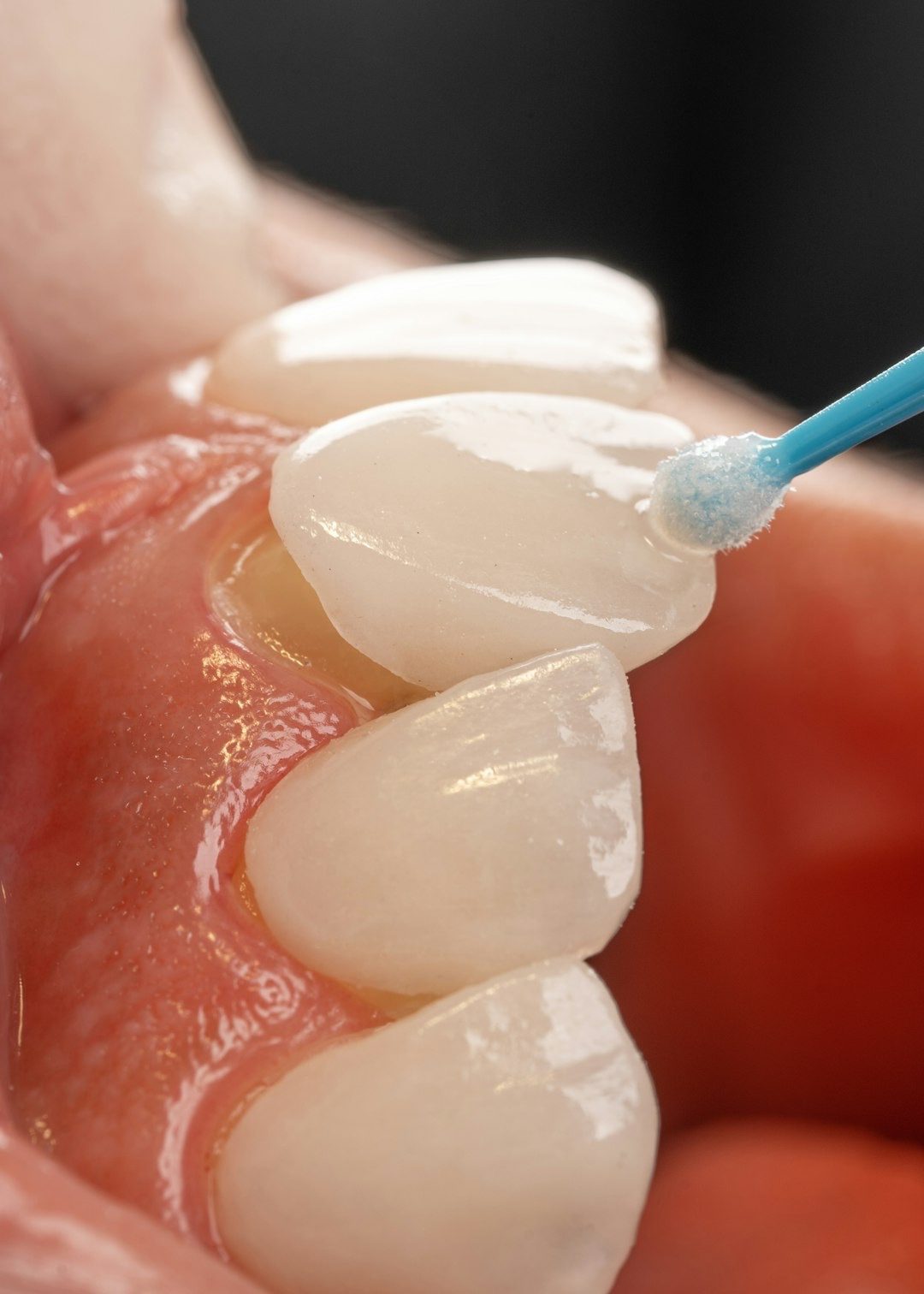
Composite bonding is a single-visit cosmetic procedure in which a tooth-coloured resin is shaped directly onto the front surface of a tooth, hardened with a blue curing light, and polished to a natural finish. The composite material is the same kind we use for tooth-coloured fillings — it bonds chemically to the enamel beneath, takes colour, translucency and shape like a natural tooth, and adds no significant bulk to the tooth itself. The result is a tooth that looks like its old self again, only better.
It helps to understand where bonding sits between the treatments people most often confuse it with. Porcelain veneers are lab-made shells that involve removing a small amount of enamel and bonding the shell onto the prepared surface — a longer-lasting result, but not reversible. Crowns wrap a tooth completely and are used when a tooth is significantly compromised — much more tooth has to be removed. Whitening changes the colour of natural enamel without altering shape. Composite bonding is the lightest-touch cosmetic option of the four — no enamel removal, no lab work, single visit, fully reversible.
We design and fit composite bonding at our Edgware practice for patients across Edgware, Stanmore, Mill Hill and the surrounding areas, typically to fix one or more of:
- A small chip on a front tooth from biting something hard, sport or trauma
- A worn-down biting edge from years of grinding or wear
- A small gap between two teeth
- A slightly rotated or under-sized tooth that looks out of proportion
- A combination of small cosmetic changes across several front teeth
The honest framing — composite bonding is a cosmetic treatment. It doesn’t fix decay, gum problems, bite issues or major alignment problems. Where the issue is structural rather than cosmetic, we’ll say so and discuss other options. Sometimes the right answer is “nothing — your smile looks fine as it is.”
Bonding vs veneers vs whitening — choosing the right option
We’ll always recommend the most conservative option that delivers the result you actually want. For most patients asking about a “smile makeover,” that means starting with the option that does the least and only escalating if the result isn’t what you’re after.
| If you want… | Consider | Cost at Campos | Reversible? |
|---|
| Brighter teeth, healthy structure and shape | Professional whitening | from £350 | Yes — no change to the tooth |
| To repair a small chip, close a small gap, lengthen a worn edge — single visit, no drilling | Composite bonding | £250 per tooth | Yes — composite can be polished off |
| To reshape several teeth, close gaps, mask deeper discolouration, achieve a longer-lasting result | Porcelain veneers | from £550 per tooth | No — small amount of enamel is removed |
| To restore a broken or root-treated tooth | A full crown | from £550 | No — significant tooth structure removed |
Consider
- Brighter teeth, healthy structure and shape
- Professional whitening
- To repair a small chip, close a small gap, lengthen a worn edge — single visit, no drilling
- Composite bonding
- To reshape several teeth, close gaps, mask deeper discolouration, achieve a longer-lasting result
- Porcelain veneers
- To restore a broken or root-treated tooth
- A full crown
Cost at Campos
- Brighter teeth, healthy structure and shape
- from £350
- To repair a small chip, close a small gap, lengthen a worn edge — single visit, no drilling
- £250 per tooth
- To reshape several teeth, close gaps, mask deeper discolouration, achieve a longer-lasting result
- from £550 per tooth
- To restore a broken or root-treated tooth
- from £550
Reversible?
- Brighter teeth, healthy structure and shape
- Yes — no change to the tooth
- To repair a small chip, close a small gap, lengthen a worn edge — single visit, no drilling
- Yes — composite can be polished off
- To reshape several teeth, close gaps, mask deeper discolouration, achieve a longer-lasting result
- No — small amount of enamel is removed
- To restore a broken or root-treated tooth
- No — significant tooth structure removed
A common scenario at our Edgware practice: a patient comes in asking about “veneers” because of a single chipped front tooth and one slightly shorter incisor. Often the right answer is whitening (so the chipped tooth blends back into the smile) plus composite bonding on the two affected teeth — a result that costs around £850 total and is fully reversible, where veneers would cost more than £1,100 and would commit the patient to a long-term porcelain restoration. Bonding is what we reach for first when the change you want is small and you want to keep your options open.
The bonding process at Campos
Composite bonding looks straightforward on paper, but the quality of the result depends entirely on the clinician’s eye for proportion, colour and surface detail. Most of the difference between a bonded tooth that disappears into the smile and one that looks “added” comes from the time the clinician spends shaping and polishing — not from the materials used.
Consultation and shade matching
Your first appointment is an unhurried conversation about what you want to change. We listen to what’s bothering you, look at the tooth or teeth in question, and check the bite to make sure bonding is genuinely the right answer rather than a workaround. If your case is suited to bonding we record the shade of your natural teeth, photograph the smile, and book the bonding appointment itself — usually within the same week.
The bonding appointment
On the day, we start by cleaning the tooth surface and isolating it from saliva — important because composite needs a dry surface to bond reliably. A mild etching gel goes on for fifteen to twenty seconds, then a bonding primer that lets the composite chemically adhere to the enamel. We then apply the composite in fine layers, shaping it freehand to the planned form. Each layer is cured with a blue light for about ten seconds before the next layer is added. Building up a single tooth typically takes twenty to thirty minutes; a multi-tooth case takes correspondingly longer.
Shaping, characterising and polishing
Once the bulk of the composite is in place we shape the final surface — biting edge, line angles, surface texture — using fine burs, abrasive strips and polishing discs. This is where the result either disappears into your smile or sits visibly on top of the tooth. We work back and forth between the tooth and a mirror you can hold yourself, so you can see and approve the shape as it develops. Final polish takes the surface from a slightly matt finish to the high gloss of natural enamel.
You leave with the finished result that day. There’s no waiting period afterwards — you can eat, drink and smile normally as soon as the appointment is over.
How long does composite bonding last and how to make it last longer
Five to eight years is the typical lifespan of composite bonding before it needs refreshing or replacing — though plenty of our Edgware patients have had bonded edges last well over ten years with good care. Where individual bonded teeth fall on that range depends on three factors: your hygiene routine, whether you grind at night, and what your bite is doing.
A few practical aftercare points for our bonding patients:
- Hygiene. Brush twice a day, floss or interdental-brush nightly, and attend hygiene visits every six months. Composite responds well to professional polishing — we can lift surface staining and refresh the gloss at each visit, which keeps the bonded teeth blending with the rest of the smile.
- Nightguards for grinders. If you grind your teeth at night, you are at meaningfully higher risk of chipping a bonded edge over time. We strongly recommend a custom nightguard once the bonding is complete. More detail on our jaw and bite page. A nightguard is cheap insurance against an early refresh.
- Mind the staining triggers. Composite is more porous than porcelain or natural enamel — coffee, tea, red wine, curry, beetroot and smoking will all stain it faster than they stain your other teeth. You don’t have to avoid these things, but be aware that heavy daily coffee or red-wine drinkers may want hygiene visits a little more often.
- Don’t open packaging with your teeth. Bonded edges chip easily on anything they weren’t designed to bite. Scissors and bottle openers exist.
- Hard biting habits. Nail-biting, pen-chewing and ice-crunching put unusual stress on bonded edges. These are habits people can ease off once they’re aware.
A bonded edge can be polished and refreshed at routine hygiene appointments — that’s part of the long-term value. When a tooth eventually does need a full re-bond, the old composite is removed cleanly and the tooth is re-bonded in a single visit. The underlying enamel is unchanged.
Pricing and finance
Composite bonding at our Edgware practice is £250 per tooth. That’s a single per-tooth rate that covers the appointment, the shaping, the polishing and any small follow-up adjustments needed in the first few weeks. We don’t quote a base price and then add on shaping or polishing as extras.
A few illustrative figures so you have something to work with:
- A single chip repair on one front tooth — £250, single appointment of around thirty minutes.
- Two-tooth case to even up a pair of front teeth — £500.
- A “social six” bond across the upper front six teeth — £1,500, single appointment of two to three hours.
- A “social eight” (upper front eight teeth) — £2,000.
Every quote we give is fixed and all-inclusive of the shaping, polish and any adjustment visits. 0% finance over up to twelve months is available via Chrysalis Finance, with loan amounts from £350 to £25,000, subject to status. For a £1,500 social-six bond spread over twelve months, that’s £125 a month.
Adult members of our dental plan receive 10% off the cost of composite bonding, alongside other treatment discounts.
Why patients choose Campos for composite bonding
A few reasons our Edgware, Stanmore and Mill Hill patients tell us they pick us for composite bonding in particular:
- Done well, not done fast. A well-bonded edge takes time to shape and polish — twenty to thirty minutes per tooth is a realistic minimum if the result is going to look natural rather than added on. We book accordingly, and we’d rather you came back for a single follow-up adjustment than rushed the polish on the day.
- Honest scoping. We won’t sell you bonding on six teeth if a single tooth is the actual problem. We won’t sell you bonding at all if whitening or porcelain veneers is the better answer for your case. Sometimes the answer is “nothing — your smile looks fine.”
- Conservative thinking. Composite bonding is genuinely reversible. Where the cosmetic change you want is small or you’re not sure how much change you actually want, it’s almost always the right place to start — porcelain remains available later if you want to step up.
- 30+ years of experience. Dr Jacobs has been designing and fitting cosmetic restorations since long before “smile makeover” was a marketing category.
- All-inclusive pricing. £250 per tooth is the figure, fixed and final — no add-ons for shaping or polishing.
- Easy to get to. We’re at 70 Edgware Way, HA8 8JS — convenient for patients travelling in from Stanmore, Mill Hill, Harrow, Colindale, Borehamwood and Barnet. Free parking on site and Edgware tube a short walk away.
Considering composite bonding?
All treatment plans start with a check-up. Book yours online at our Edgware practice — we’ll take a look at the tooth or teeth you want to change, walk you through what bonding can and can’t do for your case, and discuss whether bonding alone — or bonding combined with whitening — will get you the result you’re after. If a porcelain veneer or crown would be a better fit for what you want, we’ll say so.
We’ll always recommend the most conservative option that delivers the result you actually want. For small chips, edge repairs and minor shape changes, composite bonding is almost always the right place to start.