What is Invisalign?
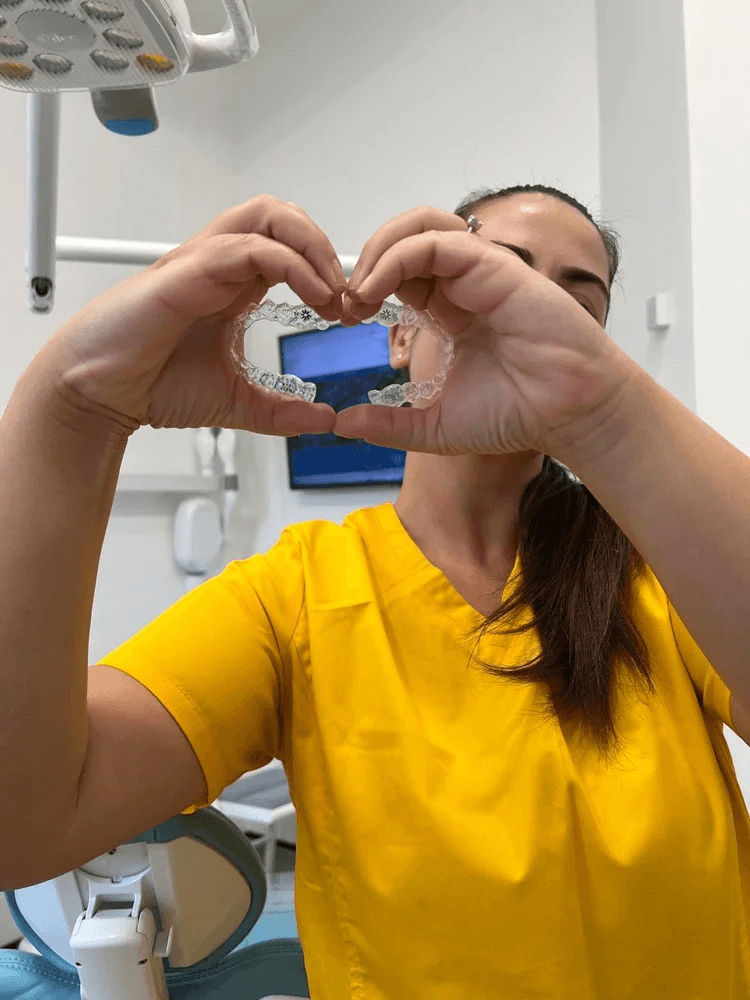
Invisalign is a clear-aligner teeth-straightening system launched by Align Technology in 1997 and now used by over 17 million patients worldwide. Instead of metal brackets and wires, it uses a series of custom-made, near-invisible aligners that gradually move your teeth into the desired position. Each set is worn for around one to two weeks before progressing to the next in the sequence.
The trays are made from a medical-grade thermoplastic called SmartTrack. It is engineered to apply gentle, consistent forces over the wear period of each aligner — not the harder, more variable pull of older clear-aligner materials. The result is movement that is more predictable and, for most patients, more comfortable than the impression most people have of “having braces.”
For most adults who would never have considered traditional fixed braces, Invisalign solves the obvious problem — the trays are clear, slim and remarkably easy to live with. From a few feet away most people genuinely won’t notice you’re wearing them. You take them out to eat, drink anything other than water, and to brush and floss, which means none of the dietary restrictions or hygiene challenges that come with brackets glued to your teeth. The flip side, which we are honest about, is that aligners only work when they are in your mouth — and that puts a significant amount of responsibility on you, the patient. Compliance is the single biggest variable in whether a case finishes on time and on plan.
Invisalign sits alongside fixed appliances under our broader orthodontics service. At Campos Dental we are an Invisalign certified provider, and the majority of our straightening cases at our Edgware practice are now treated this way — but it is not the right answer for every mouth, and the rest of this page explains where it works well, where it doesn’t, and what to expect at every step. We have tried to write this in the way we’d actually talk you through it across the desk at consultation, rather than as a marketing brochure.
Is Invisalign right for me?
The honest answer is “probably, but not certainly.” Invisalign treats most of the alignment issues we see in practice, but a small percentage of cases are genuinely better served by fixed braces or a combined approach. At your consultation we’ll look at your bite, take digital scans, run a 3D simulation, and tell you straight which option will get you to the result you actually want.
Crowding
This is the most common reason adults come to see us about straightening. Teeth that have shifted over the years, a wisdom-tooth shove from behind, or simply never had room to begin with — Invisalign handles mild and moderate crowding very well. We create space either by gentle expansion of the arch, by small amounts of interproximal reduction (IPR — a polish of enamel between certain teeth, less than the thickness of a credit card), or by a combination of both. Severe crowding that would traditionally need extractions is more nuanced and we’ll be honest with you if that is your situation.
We see a lot of “late teen relapse” cases at our Edgware practice — adults in their thirties and forties whose teeth straightened with braces in their teens and then drifted back over the following decades because retainers were not kept up. These cases tend to respond extremely well to a short course of Invisalign Lite, often in six to nine months, because the underlying biology is already set up to let the teeth move back into the positions they once held.
Spacing and gaps
Gaps between teeth — whether a single midline diastema or generalised spacing across the arch — close very predictably with aligners. The teeth simply tilt and translate toward each other through the planned sequence. Patients are often surprised at how short these cases can be: a mild spacing case treated with Invisalign Express can finish in three to six months. The thing to watch for in spacing cases is the cause of the spacing — if there is a missing tooth or a peg-shaped lateral incisor involved, the right answer may be straightening followed by a small amount of composite bonding or a single veneer to finish the space appropriately, rather than trying to close everything with aligners alone.
Crossbite, deep bite and underbite
Bite issues — where the upper and lower teeth meet incorrectly — are where Invisalign has come a long way in the last decade. Mild to moderate crossbites, deep bites and underbites can all be improved with modern aligner protocols using attachments and small rubber elastics worn from buttons on certain teeth. The current generation of SmartTrack material and the more recent ClinCheck features for bite correction make many cases tractable that would have been impossible with earlier aligner systems. Severe skeletal bite discrepancies, particularly in cases that would historically have been considered for jaw surgery, are still best assessed by a specialist orthodontist and may need fixed appliances or a combined approach.
What Invisalign won’t fix
We believe in being upfront about limitations. Invisalign struggles with:
- Very large rotations of premolars and molars at the back of the mouth
- Significant vertical movement of teeth — pulling a buried tooth down into the arch, for example
- Severe skeletal bite issues that need orthognathic input
- Cases requiring extractions to create major space, where movement control is harder
In any of these situations we will either combine Invisalign with another approach or refer you to a specialist orthodontist. We don’t take on cases we don’t believe will get a good result.
The Invisalign process at Campos Dental
Treatment runs through a series of well-defined stages. You’ll always know where you are in the journey and what comes next.
Consultation and 3D ClinCheck preview
Your first visit is an examination, £65 as a new patient or £50 as an existing patient, and the Invisalign assessment, the digital scan and the ClinCheck preview carry no separate charge on top of that fee. We take a full clinical history, examine your teeth and bite, photograph and X-ray where useful, and capture a digital scan of your mouth with our intra-oral scanner — no goopy impression trays. The scan is then planned in ClinCheck, Invisalign’s planning software, and you come back to see a 3D simulation of how your teeth will move week by week through to the finished result. This is one of Invisalign’s biggest advantages: patients we see from Edgware, Stanmore and Mill Hill can watch the predicted outcome before committing to treatment.
The ClinCheck stage is also where we have the most useful conversations. You can ask for the front teeth to be tweaked slightly differently, for a particular rotation to be over-corrected, or for the bite to be left a millimetre wider or narrower in a given spot. Nothing is locked in until you sign off the plan. This is a far more collaborative process than the days of “we’ll just put the braces on and see what happens” — you have real input into the target before the manufacturing process begins.
Manufacture of your aligners
Once you approve the plan, your full sequence of aligners is manufactured by Align Technology in their lab and shipped to us, typically within two to three weeks. For a typical Comprehensive case this might be 30 to 50 individual trays; a Lite case might be 14 to 20. You collect them as a batch, not one at a time, so once you start you have everything you need to keep moving forward at home. Each aligner is engraved with a small code so you always know which number you are on and which arch it belongs to — handy when both upper and lower trays look superficially identical.
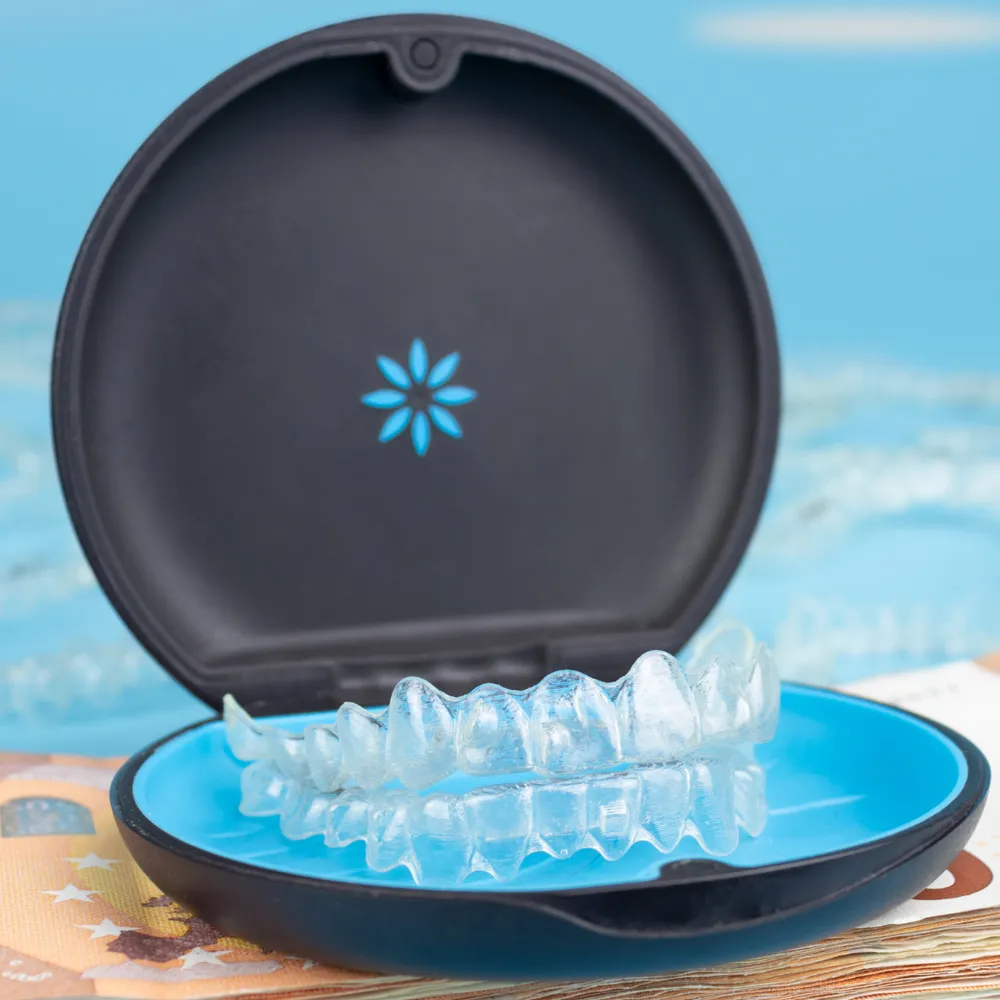
Daily wear
You wear each aligner for around one to two weeks (your plan tells you which), 20–22 hours a day, removing them only to eat, drink anything other than water, and to brush and floss. The single most important factor in a successful Invisalign result is wear time. Patients who genuinely manage 22 hours a day track their plan well. Patients who routinely leave them out for half the day will find treatment slows down, refinements are more likely, and the final result drifts from the ClinCheck preview.
Many of our Edgware Invisalign patients find the first week the hardest — speech is slightly muffled for a day or two, you become very aware of the trays, and there’s a learning curve around when to take them out and where to put them. By week two the trays feel like part of you. By month two they are fully background and you genuinely forget you’re wearing them, except when it’s time to eat.
Attachments and IPR
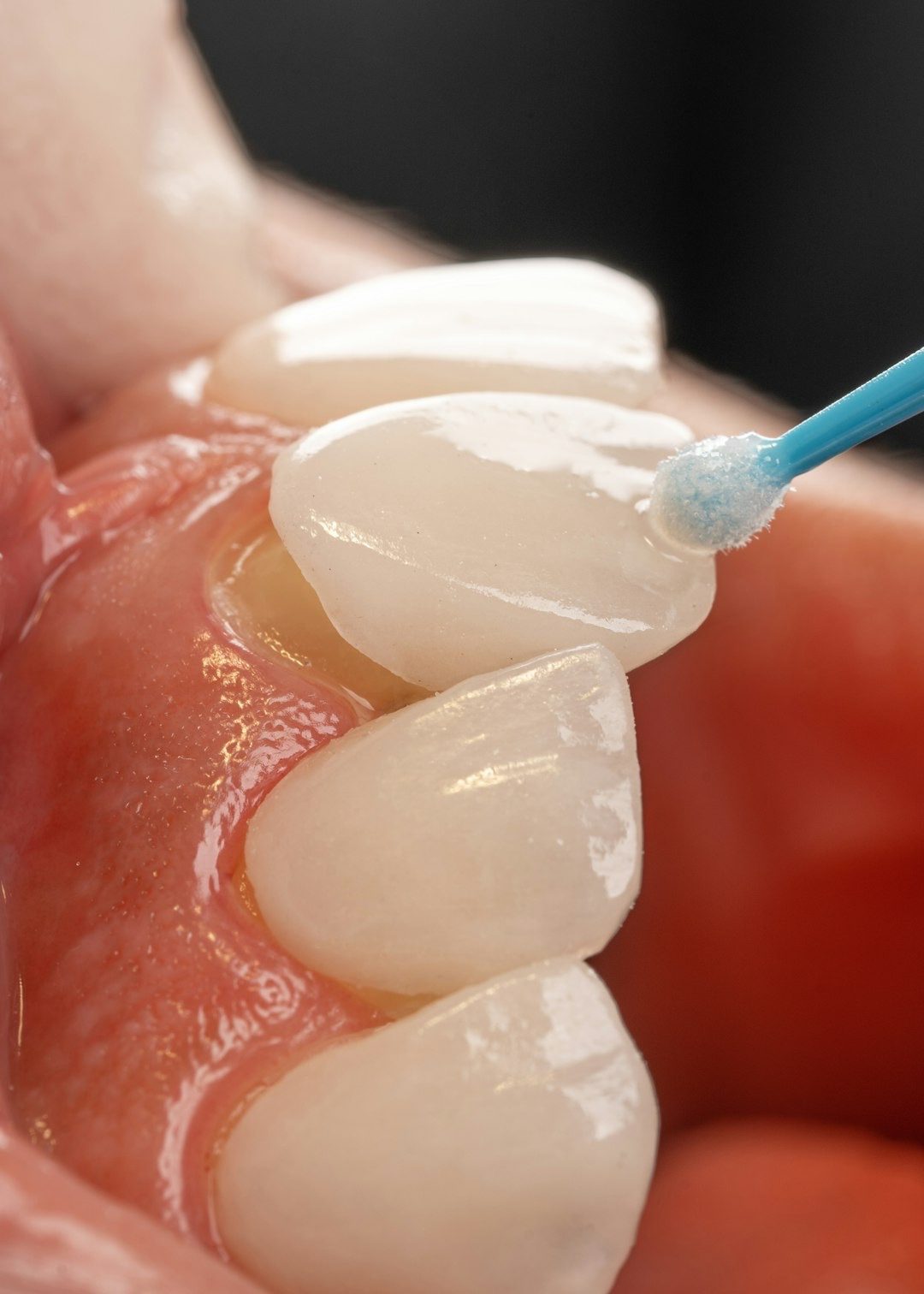
Most cases involve some attachments — small, tooth-coloured composite bumps bonded onto a handful of teeth at the start of treatment to give the aligner something to grip. They are essential for the trickier movements: rotating a canine, extruding a short tooth, or controlling the root of a tipping incisor. They stay on for the whole treatment and come off cleanly at the end. Some cases also involve IPR, the gentle interproximal reduction described in your ClinCheck plan — a small polish of enamel between specific teeth to create space, well within safe limits. We only do IPR where the plan requires it.
Progress reviews
You’ll see us every six to eight weeks for a brief progress check. We confirm the teeth are tracking as the plan predicted, check the attachments are intact, and answer any questions. These appointments are quick — usually 15 to 20 minutes — and we try to schedule them around your working hours. If something is not tracking we catch it early and adjust, rather than discovering a problem at the end.
Refinements
Almost every Invisalign case finishes with a refinement stage — a short, second set of aligners to fine-tune the result after the main sequence. This is not a failure; it is built into the protocol. Teeth move biologically, and biology has variation. Most refinements add four to eight weeks and a handful of additional trays. We include up to two rounds of refinements in our standard Comprehensive fee, so there is no surprise charge at the finish line.
Invisalign tiers — Express vs Lite vs Comprehensive
Not every case needs the full Invisalign Comprehensive package. Align Technology offers a tiered range of products, which means we can match the treatment to your case — and your budget — without overselling.
Invisalign Express
For very minor corrections — small relapses after previous orthodontic work, a single rotated tooth, a small midline gap. Up to seven aligners per arch, treatment typically three to six months, no attachments or IPR in most cases. The lowest-cost entry point, suitable only for a narrow band of cases.
Invisalign Lite
The most popular option for adults at our Edgware practice. Up to 14 aligners per arch, treatment typically six to nine months. Suits mild-to-moderate crowding and spacing, minor bite improvements, and post-orthodontic relapse cases. Includes attachments and IPR where indicated.
Invisalign Comprehensive
The full package for more complex cases — moderate-to-severe crowding, bite correction, larger movements. Unlimited aligners across the treatment, typically nine to eighteen months of active wear, and the most flexibility for mid-treatment plan adjustments. This is where most of our combined cases sit.
We will tell you which tier suits your case at the consultation, and we will say so honestly if Lite will do the job rather than upselling you to Comprehensive.
Living with Invisalign day to day
Most patients want to know what daily life looks like in practical terms — at work, on a night out, on holiday, eating with friends. Here is how the routine tends to settle for our Edgware patients after the first couple of weeks.
A typical day
You put your aligners in last thing at night and sleep in them. They come out for breakfast, you eat normally, brush, rinse the trays, and pop them back in. They come out again at lunchtime — at your desk, in a cafe, wherever — for the time it takes to eat, then back in. Same at dinner. Aim to have them in everywhere else, including for snacks and any drink other than water. If you total it up, the trays are in for around 22 hours, out for around 2.
Cleaning your aligners
Rinse them under lukewarm — not hot — water every time you take them out. Brush them gently with a soft toothbrush and a small amount of antibacterial soap, not toothpaste (toothpaste is mildly abrasive and dulls the trays over time). Avoid mouthwash for soaking, as some formulations stain the plastic. Once a week, you can use Invisalign’s own cleaning crystals or a generic retainer-cleaning tablet for a thorough soak. Clean trays do not smell or look cloudy; trays that have been left untouched do.
Eating out and socialising
The discreet design genuinely works socially. Friends and colleagues do not normally notice the trays unless you point them out. At restaurants you slip them out before the menu arrives, eat your meal, then excuse yourself to the bathroom briefly to brush and replace them before dessert or coffee. Most patients quickly develop a routine of carrying a small Invisalign case and a travel toothbrush in their bag. The thing to avoid is sipping a long glass of wine or a coffee through a meal with the trays in — that’s where staining and dental risk creep in.
Travel and holidays
Pack the spare aligner before and after your current one as a precaution against losing a tray on the road. Keep them in your hand luggage, not your checked bag. Climate is not an issue — they are stable across normal temperature ranges — but do not leave them in a hot car or by a pool in direct sun, as the plastic can deform. Most patients find Invisalign genuinely easier to travel with than fixed braces.
Speech and lisp
Around a third of patients notice a slight lisp on certain “s” and “th” sounds during the first week of treatment. Your tongue adapts very quickly — by day three to five the lisp has usually gone. If you have a presentation in week one, practice your slides aloud at home a few times in the days before. After that initial adjustment, Invisalign has essentially no impact on speech.
Treatment time — what 9 to 18 months actually looks like
The 9 to 18 months figure is an average, and averages hide a lot. Here is what the real-world rhythm tends to look like for an Edgware patient on a typical Comprehensive case.
- Month 1: consultation, scans, ClinCheck approval, aligners ordered.
- Month 2: aligners collected, attachments bonded, IPR if needed at this stage, first aligner fitted. This appointment runs around 45 minutes and is the longest one in the whole treatment.
- Months 3 to 9: home wear, changing aligners every one to two weeks per your plan, with a 15-minute progress check every six to eight weeks.
- Months 9 to 12: completion of the main aligner sequence. A new scan is taken to plan refinements.
- Months 12 to 14: refinement aligners, a short additional sequence to perfect the result.
- Month 14: attachments removed, final polish, scans taken for your Vivera retainers.
- Month 15 onwards: retainer phase begins — full-time for three months, then nights only, indefinitely.
A Lite case compresses much of the above into six to nine months. A complex Comprehensive case with bite work can run beyond 18 months, particularly where compliance is patchy or where the original plan needs significant mid-treatment revision. We’ll give you a personal estimate at consultation rather than a textbook figure.
Retainers — protecting the finished smile
Almost everyone underestimates this part. Teeth have a lifelong tendency to drift, and that drift does not stop because you have finished active treatment. Without good retention, much of the careful work of the previous year quietly undoes itself over five to ten years. We see this in adults who had orthodontics as teenagers, were given retainers for a few months, stopped wearing them, and now want Invisalign to fix the relapse.
At the end of treatment we provide a set of clear Vivera retainers, manufactured by Align Technology from the same kind of material as your aligners but slightly thicker for durability. They look much like the final aligner in your sequence. The standard protocol is:
- First three months: full-time wear, 20–22 hours a day, just like the active phase.
- Months three onwards: nights only, every night, indefinitely.
- Long term: some patients drop back to a few nights a week after several years of stability; the right rhythm depends on how prone your case is to relapse.
We also offer a thin fixed bonded retainer behind the front teeth as an additional safeguard, particularly for cases that started with significant crowding of the lower incisors — the most relapse-prone area in the mouth. Most patients find a combination of fixed lower retainer plus nightly upper Vivera the most reliable long-term arrangement.
Vivera retainers wear out, typically over three to five years depending on whether you grind at night. We supply replacement sets at a reduced fee.
Invisalign vs fixed braces — making the decision
Both work. The right choice depends on your case, your lifestyle and your tolerance for compromise. Here is the honest comparison.
| Factor | Invisalign | Fixed braces |
|---|
| Appearance | Near-invisible | Visible (ceramic options reduce this) |
| Comfort | No wires or brackets — minimal soft-tissue irritation | Initial rubbing common; gradually settles |
| Eating | No restrictions — trays out for meals | Avoid hard, sticky, crunchy foods |
| Cleaning | Brush and floss normally | Significantly harder; risk of decalcification |
| Compliance | Entirely dependent on you wearing them 20–22 hrs/day | Always on — works whether you co-operate or not |
| Complex cases | Excellent for mild-to-moderate; limits at the severe end | Best for severe rotations, large movements, extraction cases |
| Treatment time | 9–18 months for most adults | 12–24 months typical |
| Cost at Campos | Typically from £1,600, subject to assessment | Quoted per case; broadly similar range |
Invisalign
- Appearance
- Near-invisible
- Comfort
- No wires or brackets — minimal soft-tissue irritation
- Eating
- No restrictions — trays out for meals
- Cleaning
- Brush and floss normally
- Compliance
- Entirely dependent on you wearing them 20–22 hrs/day
- Complex cases
- Excellent for mild-to-moderate; limits at the severe end
- Treatment time
- 9–18 months for most adults
- Cost at Campos
- Typically from £1,600, subject to assessment
Fixed braces
- Appearance
- Visible (ceramic options reduce this)
- Comfort
- Initial rubbing common; gradually settles
- Eating
- Avoid hard, sticky, crunchy foods
- Cleaning
- Significantly harder; risk of decalcification
- Compliance
- Always on — works whether you co-operate or not
- Complex cases
- Best for severe rotations, large movements, extraction cases
- Treatment time
- 12–24 months typical
- Cost at Campos
- Quoted per case; broadly similar range
We’ve published a fuller decision frame at the Invisalign vs fixed braces guide. The short version: for the great majority of adults asking the question, Invisalign is the right answer. For teenagers with reliability issues, complex bites, or cases needing extractions, fixed braces still win.
Combining Invisalign with whitening, veneers or bonding
Many of our cosmetic patients arrive wanting “a nicer smile” and are not sure whether they need straightening, whitening, porcelain veneers, composite bonding, or some combination. The right answer is almost always sequencing — and almost always doing less than you initially thought you needed.
The principle is to start with the most conservative option and only add the next layer if it is genuinely needed. For most patients that means straightening first, whitening second, and only considering veneers or bonding for any final cosmetic refinements. This sequence protects the most tooth structure, leaves the most options open if you change your mind in later years, and tends to produce a result that looks like a better version of your own smile rather than a generic “cosmetic” smile.
- Step one — Invisalign. Straightening alone makes a remarkable difference to most smiles. We are often surprised at how many patients decide they are happy with the result of Invisalign and never go further.
- Step two — Whitening. Once teeth are in their final position we can plan whitening accurately, because the surfaces are now where they need to be. We typically offer take-home whitening trays after the active aligner phase, often using your final aligner shape as the whitening tray with minor modification. More detail on the teeth whitening page.
- Step three — Veneers or composite bonding, if needed. With teeth straight and white, many patients no longer want or need veneers. For those who do — usually to fix chips, worn edges, or persistent shape concerns — we can now plan the cosmetic work to a much higher standard than we could on misaligned teeth.
Done in this order, the cosmetic result is conservative, durable and predictably beautiful. Done in reverse, we’d be doing more drilling, on more teeth, for a worse result. That’s not the path we take at Campos.
Pricing and finance
We have always taken the view that quoted prices belong on a website, not hidden behind a consultation. Patients deserve to know roughly what they are looking at before they walk through the door.
Invisalign at our Edgware practice typically starts from £1,600 and is quoted case-by-case at consultation. Every case is subject to assessment — the exact figure depends on your case complexity, the tier we recommend (Express, Lite or Comprehensive) and the number of aligners needed. Our full price list is on the fees page.
We give you one fixed all-inclusive figure at your consultation, not a base price with surprises later. The section below sets out exactly where the line between included and extra sits, and Dr Jacobs has taken the whole figure apart line by line in what Invisalign really costs in Edgware, including the questions worth asking anyone else who quotes you.
We offer 0% finance via Chrysalis Finance, with loan amounts from £350 to £25,000 over up to twelve months at 0% APR, subject to status. For a £3,500 Invisalign case spread over 12 months that works out at just under £292 a month. We can walk you through the application at consultation — full details on the finance page.
Invisalign sits outside the 10% treatment discount that members of our adult dental plan receive on almost everything else — porcelain veneers, whitening, implants, restorative work and fixed braces all attract the plan discount, but Invisalign does not. The plan still has its place for patients who plan to stay with us long term, because it covers your routine examinations and hygiene visits — both of which sit alongside an active Invisalign treatment — and the 10% discount applies to any further restorative or cosmetic work you may want once your teeth are aligned.
We won’t ask for the full amount up front. Most patients pay a deposit at the start of treatment to cover the planning and scanning stage, then either settle the balance at the fitting of the first aligner or set up a finance agreement that begins from that point. We’re happy to walk through whichever route works best for your circumstances at the consultation.
What the all-inclusive price covers
Patients comparing Invisalign in Edgware and the surrounding area tell us the same thing: the headline number is rarely what decides how much they end up paying. What decides it is where the line sits between “included” and “extra”. Here is exactly where ours sits.
Included in the figure we quote you at consultation:
- The full sequence of aligners for both arches, however many trays your ClinCheck plan calls for.
- Digital scanning and ClinCheck planning, including the revisions you ask for before you sign the plan off.
- Attachments and IPR where your plan needs them, both the bonding on at the start and the polishing off at the end.
- Every progress review through the active phase, roughly one appointment every six to eight weeks.
- Up to two rounds of refinement aligners after the main sequence, so fine-tuning the result is not a separate bill.
- A set of Vivera retainers made from your final scan.
Quoted separately, and always before we start the work:
- A replacement tray if you lose one, quoted at the time.
- Replacement Vivera retainers in later years, quoted at the time.
- A thin fixed retainer bonded behind the front teeth, if you choose one as an extra safeguard, quoted at the time.
- Anything you choose to add afterwards, such as whitening, composite bonding or a crown.
Why patients choose Invisalign at Campos Dental
A few reasons our Edgware, Stanmore and Mill Hill patients tell us they pick us for Invisalign in particular:
- Certified Invisalign provider status. We are an accredited provider, which means access to the full Invisalign product range — Express, Lite, Comprehensive, Teen, and the more advanced features for complex cases. Not every practice offering aligner treatment is on the certified provider tier.
- 3D preview at consultation. You see your predicted outcome on screen before committing to treatment, and if Invisalign isn’t right for you we say so.
- Honest scoping. We won’t sell you a Comprehensive case if Lite will do the job. We won’t sell you Invisalign at all if fixed braces would give a better result for your specific situation.
- All-inclusive pricing. One fixed figure covering aligners, reviews, refinements and retainers. No surprise charges at the end of treatment.
- In-house cosmetic team. If you want to combine straightening with whitening or veneers as part of a smile makeover, the planning happens in one place with one team.
- Easy to get to. We’re at 70 Edgware Way, HA8 8JS — straightforward for patients travelling in from Stanmore, Mill Hill, Harrow, Colindale, Borehamwood and Barnet. Free parking on site and Edgware tube a short distance away.
Considering Invisalign?
All treatment plans start with a check-up. Book yours online at our Edgware practice — we’ll take a look at your teeth, run a 3D ClinCheck simulation so you can see the predicted outcome, talk you through the options, and only recommend treatment if it’s genuinely right for you. If you have a wedding, graduation or other event you’re working backwards from, mention it when you get in touch — we can plan timing around your date.
Treatment isn’t right for everyone, and we’ll be the first to tell you if it isn’t right for you. But for the great majority of adults who would never have worn metal braces, Invisalign quietly delivers the smile they have wanted for years.
Further reading from the blog