
TMJ Disorder Treatment in Edgware
Lasting relief from jaw pain, clicking, tension headaches and tooth grinding. Custom-made splints, bite analysis and clear referral pathways for complex cases.
Book Online opens in our secure Dentally Portal — verified by SMS. All treatment plans start with a check-up.
from £450

- Relief from jaw pain and tension headaches
- Custom-made night splints to stop teeth grinding
- Bite analysis to find the root cause
- Onward referral to maxillofacial specialists where needed
- Protection of existing dental work
How TMJ inflicts pain
The temporomandibular joint sits just in front of each ear, where the lower jaw meets the skull. When the small cartilage disc inside the joint slips out of position, or the joint becomes inflamed, every movement of your jaw — chewing, talking, yawning — grinds bone against bone and irritates nearby nerves and muscles.
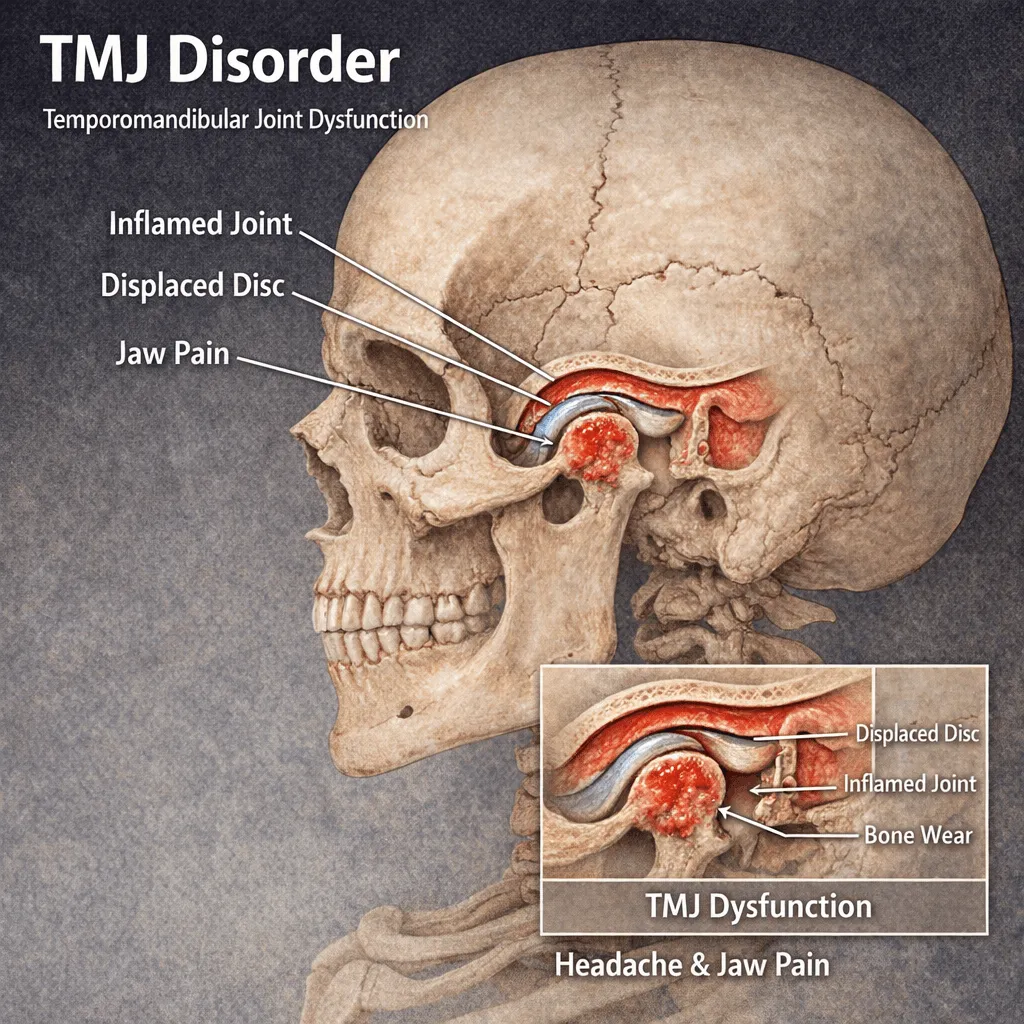
That joint sits beside a dense network of nerves and muscles running through your temples, cheeks, neck and ears — which is why TMJ problems so often show up as headaches, earache or neck tension rather than obvious jaw pain. Patients sometimes come to us after months of being investigated for sinus problems, migraines or ear infections, only for the cause to turn out to be their bite.
Symptoms of TMJ disorder
When the joint isn’t working properly, you may experience:
- Jaw pain or tenderness, especially in the morning
- Clicking, popping or grating sounds when opening or closing your mouth
- Headaches and migraines, particularly tension headaches around the temples
- Neck and shoulder pain that doesn’t have an obvious cause
- Difficulty chewing or pain on biting
- Lockjaw or restricted jaw movement
- Tinnitus (ringing in the ears) or dizziness
What causes TMJ disorder?
- Bruxism — habitually grinding or clenching your teeth, often unconsciously at night
- Trauma — a blow to the head or jaw
- Arthritis — osteoarthritis or rheumatoid arthritis affecting the joint
- Malocclusion — a bite that puts uneven force through the joint
- Stress — which often manifests as jaw clenching
How we treat TMJ at Campos Dental
1. Custom night splints
A precisely-fitted hard acrylic splint, worn at night, that protects your teeth from grinding and helps the joint rest. Most patients notice improvement within 2–4 weeks. From £450.
2. Bite analysis and correction
Sometimes a high spot on a filling or crown is enough to throw the whole bite out of balance. We identify and adjust these carefully, often as part of broader general dental care.
3. Orthodontic correction
For TMJ caused by significant bite issues, orthodontics — including Invisalign — can give long-term resolution by re-aligning the way your upper and lower teeth meet.
4. Onward referral
For severe TMJ issues that don’t respond to conservative treatment, we work with trusted maxillofacial specialists nearby.
Exercises and self-management
Splints and bite work do most of the heavy lifting, but a few minutes of daily self-care meaningfully speeds up recovery. None of these need any equipment, and patients who do them consistently for two or three weeks usually notice a real difference.
Resting position — teeth apart, tongue up
Your upper and lower teeth aren’t meant to touch except when you chew or swallow. The natural resting position is lips together, teeth slightly apart, tongue gently resting against the roof of your mouth. Most TMJ patients have drifted into a habit of holding their teeth in light contact through the day, which keeps the chewing muscles constantly working. Sticking small coloured dots around the kettle, the monitor and the bathroom mirror works well as a prompt to check your jaw is resting open.
Gentle jaw-stretch sequence
Twice a day, in front of a mirror:
- Controlled open-and-close. Slowly open your mouth as wide as is comfortable (stop short of any click or sharp pull), hold five seconds, slowly close. Ten times. The aim is smooth, midline opening — not forcing range.
- Side-to-side. Teeth slightly apart, gently move your lower jaw to the right, hold five seconds, return to centre. Repeat left. Ten times each side.
- Resisted opening. Place a fist gently under your chin and try to open your mouth slowly against the light resistance — five seconds open, five rest, five repetitions. This strengthens the joint-stabilising muscles.
If any of these provoke sharp pain or worsen symptoms over a few days, stop and let us know — the routine should ease tension, not aggravate it.
Neck and posture
The jaw and neck share muscle attachments and nerve supply, so a stiff, forward-held neck pulls on the jaw mechanically and amplifies TMJ symptoms. A few minutes of slow neck rolls, shoulder rolls and chin tucks each morning eases the load. If you work at a screen, raising the monitor so the top is roughly at eye level — and sitting back into the chair rather than craning forward — removes a surprising amount of jaw tension over a few weeks.
What to avoid while symptoms are active
- Chewing gum, biting nails, opening packets with your teeth
- Large mouthfuls — cut sandwiches and apples into smaller pieces
- Resting your chin on your hand at a desk
- Sleeping on your front with your jaw turned against the pillow
A warm compress over the jaw and temples for ten to fifteen minutes eases muscle tightness when symptoms flare. Over-the-counter ibuprofen (taken with food) helps short-term while a splint is being made.
TMJ in Edgware, Stanmore and Mill Hill — when to see a dentist vs your GP
Patients often aren’t sure whether jaw and head pain is a dental problem or a medical one — and the wrong starting door means months of investigations that don’t get to the cause.
Start with us if you have: jaw clicking, popping or grating; morning jaw stiffness or grinding noticed by a partner; tension headaches around the temples; pain on chewing; a feeling your teeth don’t meet properly; worn or chipped tooth edges; or ear fullness with no infection.
Start with your GP if you have: sudden severe one-sided facial pain with no obvious jaw component; visual disturbance, nausea or photophobia with the headaches; ear discharge or hearing loss; or spreading facial swelling with fever.
In practice many cases need both. Patients from Edgware, Stanmore and Mill Hill regularly come to us first for the dental assessment and loop their GP in as needed; the contact page is an easy way to book an assessment. The fees page sets out assessment and splint pricing, and the adult dental plan covers routine examinations.
Don’t put up with it
TMJ symptoms rarely fix themselves, but they’re highly treatable when the right cause is identified. The sooner we look, the simpler the answer usually is — and the less likely you are to need anything more involved than a well-made nightguard and a few weeks of patience.
Frequently asked
What is TMJ disorder?
Is my night-time grinding causing this?
How much does a night splint cost?
When do I need a specialist?
Are there treatments for TMJ beyond a nightguard?
Can stress really cause TMJ pain?
You might also be looking at.

Dental Crowns
from £550Custom-made caps that restore broken, cracked or root-treated teeth. Available in porcelain, ceramic and metal options to suit appearance, position and budget.
Learn more
General Dentistry
from £50Routine, preventative and family dentistry — the foundation of a healthy smile. Check-ups, hygiene visits, tooth-coloured fillings, and oral cancer screening for every age.
Learn more
Orthodontics
from £1,500Straighter teeth for healthier mouths and more confident smiles. Fixed metal and ceramic braces alongside Invisalign clear aligners for children, teens and adults.
Learn moreFind us in Edgware.
Free 30-minute parking out front and a step-free entrance. Pop in for a look or call ahead — we usually answer within a few rings.
Campos Dental
70 Edgware Way
Edgware, HA8 8JS
Call us
020 3971 2000Contact us
Send us a message →Opening hours
- Mon – Fri 9:00 am – 5:30 pm (closed 1–2 pm)
- Sat by appointment
- Sun closed
Considering this treatment?
All treatment plans start with a check-up. Book yours online — we'll talk you through the options for this treatment, explain pricing, and only recommend treatment if it's genuinely right for you.
Book Online opens in our secure Dentally Portal — verified by SMS. All treatment plans start with a check-up.