What porcelain veneers actually are
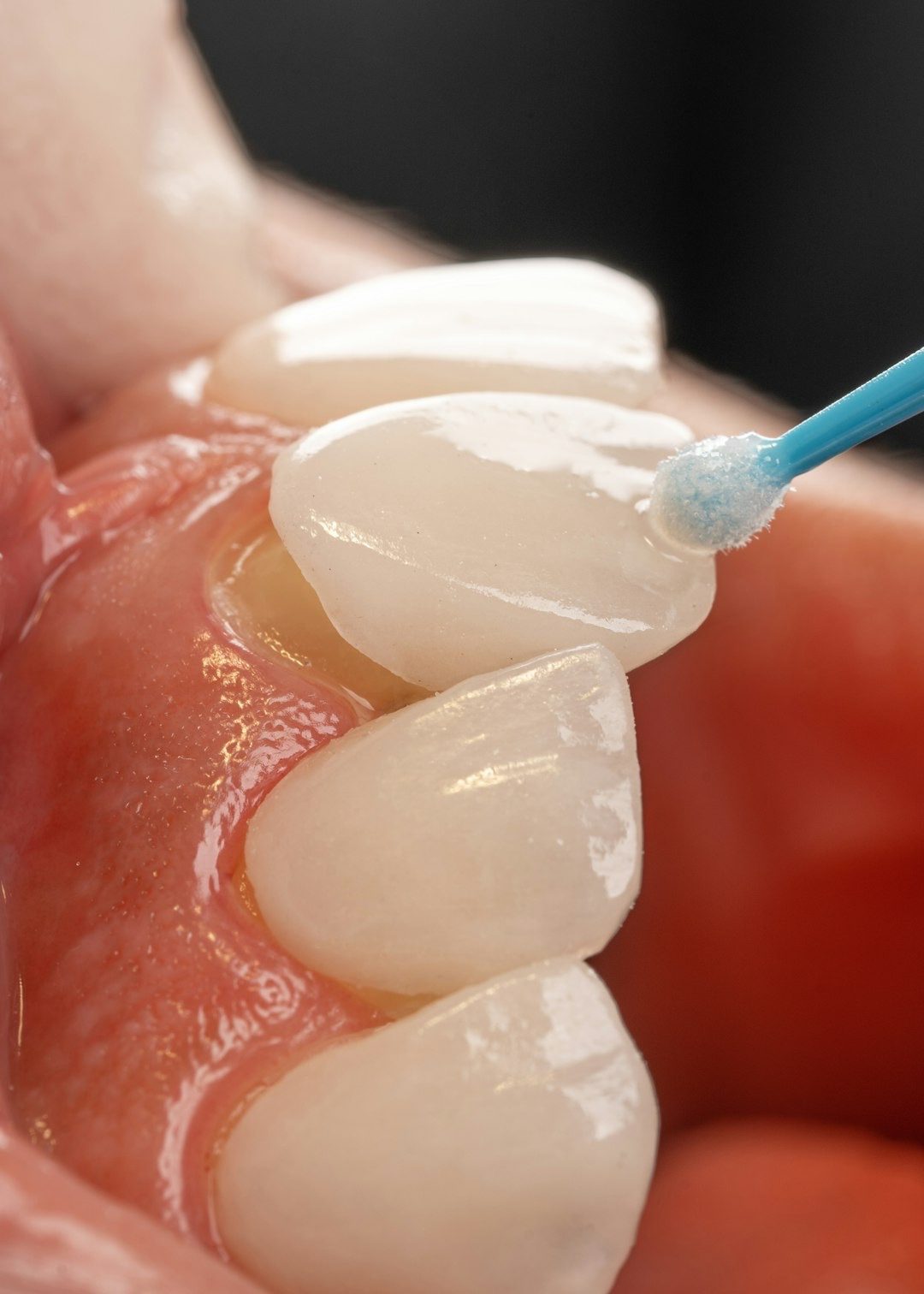
Porcelain veneers are thin, custom-made shells of dental porcelain bonded to the front surface of your natural teeth. Each one is between about 0.3mm and 0.7mm thick — a fraction thicker than a contact lens — and is hand-built by a master ceramist to match the colour, translucency and surface character of the teeth around it. Once bonded with modern dental adhesive, the porcelain becomes integral to the tooth and reinforces what’s beneath, rather than sitting on top of it like a temporary covering.
It helps to understand where veneers sit between the two treatments people most often confuse them with. A crown wraps a tooth completely, like a thimble over a finger, and is used when a tooth is broken, root-treated or significantly compromised — much more tooth has to be removed. Composite bonding is tooth-coloured resin shaped directly onto the tooth in a single visit, with no enamel removed at all — quicker and reversible, but softer and shorter-lived than porcelain. Veneers sit between the two — much more conservative than a crown, much more durable than composite, and shaped to a level of finesse that only a lab-built restoration can really deliver.
We design and fit veneers at our Edgware practice for patients across Edgware, Stanmore, Mill Hill and the surrounding areas, typically to fix one or more of:
- Teeth that are dulled or discoloured and don’t respond well to whitening alone
- Chips, worn edges or uneven biting lines from years of wear
- Small gaps and slightly rotated teeth where the patient doesn’t want orthodontics
- A combination of the above, as part of a wider smile design
The honest framing — veneers are a cosmetic treatment, not a health treatment. They don’t fix decay, gum problems or bite issues. We always make sure the underlying mouth is in good condition before placing any porcelain.
Veneers vs composite bonding vs whitening vs crowns
We’ll always recommend the most conservative option that delivers the result you actually want. That principle drives the conversation at every cosmetic consultation, and it’s why we lead with this comparison rather than push you toward the most expensive option.
| If you want… | Consider | Cost at Campos | Reversible? |
|---|
| Brighter teeth, with healthy structure and good shape | Professional whitening | from £350 | Yes — no change to the tooth |
| To repair a small chip, close a small gap, lengthen a worn edge — single visit, no drilling | Composite bonding | £250 per tooth | Yes — composite can be removed |
| To reshape several teeth, close gaps, mask deeper discolouration, achieve a longer-lasting result | Porcelain veneers | from £550/tooth | No — small amount of enamel is removed |
| To restore a broken or root-treated tooth | A full crown | from £550 | No — significant tooth structure removed |
Consider
- Brighter teeth, with healthy structure and good shape
- Professional whitening
- To repair a small chip, close a small gap, lengthen a worn edge — single visit, no drilling
- Composite bonding
- To reshape several teeth, close gaps, mask deeper discolouration, achieve a longer-lasting result
- Porcelain veneers
- To restore a broken or root-treated tooth
- A full crown
Cost at Campos
- Brighter teeth, with healthy structure and good shape
- from £350
- To repair a small chip, close a small gap, lengthen a worn edge — single visit, no drilling
- £250 per tooth
- To reshape several teeth, close gaps, mask deeper discolouration, achieve a longer-lasting result
- from £550/tooth
- To restore a broken or root-treated tooth
- from £550
Reversible?
- Brighter teeth, with healthy structure and good shape
- Yes — no change to the tooth
- To repair a small chip, close a small gap, lengthen a worn edge — single visit, no drilling
- Yes — composite can be removed
- To reshape several teeth, close gaps, mask deeper discolouration, achieve a longer-lasting result
- No — small amount of enamel is removed
- To restore a broken or root-treated tooth
- No — significant tooth structure removed
Most patients who come to us asking about a “smile makeover” are surprised at how often the right answer is the row above the one they expected. Whitening alone makes a remarkable difference. Whitening plus a single veneer on a chipped or discoloured front tooth often achieves the result a patient thought needed six. The goal is the smile you want, with the least intervention possible — not the longest invoice we can write.
The Campos smile-design process
Designing a set of veneers is genuinely closer to a craft than a procedure. The result has to flatter the proportions of your face, your smile line, your skin tone and your personality. Get any of those wrong and the veneers look “right” in isolation but wrong on you. Our smile-design process is built around catching this before any porcelain is made, not after.
Consultation and photography
Your first appointment is an unhurried conversation about what you want to change. We listen first — to what is bothering you, what you do and don’t want to look like, and what your reference points are (photos of your own smile from earlier years are often the most useful brief). We then examine your teeth and gums, check the bite, and photograph your smile from multiple angles — relaxed, smiling, talking. These photographs become the working brief for the design and for the ceramist later in the process.
Digital mockup
Our Edgware patients see a digital preview of the proposed result on screen before committing to anything. Using your photographs and our smile-design software we plan tooth shape, length, proportion and shade, and adjust until the simulated smile looks like the result you want. This is where you can ask for the teeth to be a little less long, or the shape a little softer, or the shade a half-step warmer. Nothing is locked in until you sign off.
Wax-up and try-in
For multi-tooth cases the master ceramist then produces a physical wax-up — a three-dimensional model of the proposed veneers built up on a cast of your teeth. We can use this model to make a temporary mock-up that we trial directly in your mouth, so you can see and feel the shapes before any preparation begins. This step is the single biggest predictor of a result you’ll be happy with. Most patients refine one or two details at this stage that they would not have spotted on a screen.
Final approval
Only once you’ve approved the design — colour, shape, length, character — do we move forward into preparation. Anyone who tells you a smile-design choice is locked in before you’ve seen and felt the proposed shapes in your own mouth is rushing the process. We don’t.
The veneer fitting process at Campos
Once the design is approved, the active treatment runs across two main appointments, typically two to three weeks apart. Here’s what happens at each stage.
Tooth preparation
At your preparation appointment we remove a small amount of enamel from the front surface of each tooth — roughly half a millimetre, sometimes a little more or less depending on the design — to make space for the porcelain. We use the approved mock-up as our guide so we only remove the enamel that’s actually needed and no more. This step is what makes porcelain veneers ultimately non-reversible. Enamel does not regenerate, and once a tooth has been prepared it will need a veneer (or a similar restoration) on it from then on. We explain this at consultation, not at preparation, so the decision is fully informed before we pick up a handpiece.
Digital impressions
After preparation we capture digital impressions of your teeth using our intra-oral scanner — no goopy impression material. The scans go to the lab along with the approved design, photographs, shade record and bite information, so the ceramist is working from a complete and accurate brief.
Lab fabrication with our master ceramist
Your veneers are then hand-built by our master ceramist over the following two to three weeks. The ceramist layers the porcelain in fine increments, building up colour, translucency and surface texture so each veneer looks like a natural tooth rather than a flat shell. This is where a smile design either does or doesn’t look real — and it’s why we work with a master ceramist rather than a high-throughput lab. Hand-built porcelain veneers have a depth of character that machine-pressed veneers simply don’t replicate.
Fit and bond
At your second visit we try the finished veneers in first, without bonding them, so you can see and feel the final result and ask for any small adjustments. Once you’re happy we clean and prepare the tooth surfaces, place the veneers with strong dental adhesive, cure the bond with a curing light, and polish the margins. You leave with the finished smile that afternoon. There is no waiting period afterwards — you can eat, drink and smile normally as soon as the appointment is over, though we recommend giving the bond 24 hours before biting into anything very hard or sticky.
How long do veneers last and how to make them last longer
10–20 years is the figure widely cited across the industry, and our experience at the Edgware practice broadly fits that range. Where individual veneers fall on the spectrum depends mostly on three factors — your hygiene routine, whether you grind at night, and whether you use your front teeth on things they were never designed to deal with.
A few practical aftercare points for our veneer patients:
- Hygiene. Brush twice a day, floss or interdental-brush nightly, and attend hygiene visits every six months. The porcelain itself doesn’t decay, but the margin where the veneer meets the tooth needs to be kept clean — that’s where any problems tend to start. Our dental hygiene team keeps margins clean and catches anything early.
- Nightguards for grinders. If you grind your teeth at night you are at meaningfully higher risk of chipping a veneer over time, and we strongly recommend a custom nightguard once your smile is finished. More detail on our jaw and bite page. A nightguard is cheap insurance against a remake.
- Don’t open packaging with your teeth. This sounds obvious, but the most common cause of a chipped veneer we see is biting through a sandwich bag, packet of crisps or roll of selotape. Scissors exist.
- Hard biting habits. Nail-biting, pen-chewing and crunching ice all stress the porcelain. Most of these are habits people can ease off once they’re aware.
- Sport. A custom mouthguard for contact sports protects veneers as well as natural teeth.
Veneers can be replaced individually if one fails — you don’t have to redo the whole set. We keep your design records on file, so a like-for-like replacement years down the line can be matched accurately to the rest of your smile.
Are veneers reversible?
The honest answer is no, and we think it’s important to say so plainly rather than gloss over it. Because we remove a small amount of enamel during preparation, and enamel doesn’t grow back, any tooth that has had a porcelain veneer placed will need a veneer — or a similar restoration like a crown — on it for the rest of its life. The tooth underneath continues to function as a healthy tooth, but the front surface is no longer the natural enamel it was before treatment.
This isn’t a reason to avoid veneers. The result is long-lasting, looks beautiful, and is well-tolerated by the underlying tooth for decades. But it is the single most important point we want patients to understand at consultation, not at preparation. Veneers are a commitment, in a way that whitening or composite bonding aren’t.
If reversibility matters to you — and for many patients, particularly younger patients, it really should — composite bonding is a genuinely reversible alternative. Composite sits on top of the enamel without any preparation, can be polished off in future without damaging the tooth, costs less per tooth, and works very well for small chips, edge repairs and minor shape changes. The trade-offs are durability and stain resistance — composite typically needs refreshing every five to eight years and is more prone to staining than porcelain. For a patient in their twenties who wants to change the look of one or two teeth without committing irrevocably, composite is often the right answer for now, with porcelain available later as a future option.
We will always raise this trade-off with you at consultation. It is not a question we want patients to discover for the first time on a competing website.
Pricing and finance
Our porcelain veneers at the Edgware practice start from £550 per tooth. That’s our published starting price — mid-market for the area. Cosmetic-led practices a short drive away typically charge £790 to £900 per tooth for comparable porcelain work, so the £550 figure is positioned to be honestly cosmetic-quality without being premium-tier in price. Full pricing for every treatment is on our fees page.
A few illustrative figures so you have something to work with:
- A single veneer to repair a chipped or discoloured front tooth — from £550, total elapsed time around four to six weeks.
- A “social six” smile (the upper front six teeth, the ones that show when you talk and smile) — from £3,300, often combined with whitening of the remaining teeth so the new veneers blend.
- A “social eight” (upper front eight) — from £4,400. The most common smile-design package for patients wanting a comprehensive change.
- Ten-veneer smile — from £5,500. Less common, usually because most patients don’t actually need this many once we’ve planned the case.
Every quote we give is fixed, single-figure and all-inclusive of consultation, design, ceramist’s lab fees, two-stage fitting and finishing polish. We don’t quote a base price and then add on. 0% finance over up to twelve months is available via Chrysalis Finance, with loan amounts from £350 to £25,000, subject to status. For a four-veneer £2,200 smile spread over twelve months, that’s around £183 a month.
Adult members of our dental plan receive 10% off the cost of porcelain veneers, alongside other treatment discounts. For patients planning more than a single veneer it’s worth checking whether joining the plan before booking makes financial sense — the discount on a four-or-more veneer case typically more than covers a year of plan membership.
Why patients choose Campos for veneers
A few reasons our Edgware, Stanmore and Mill Hill patients tell us they pick us for porcelain veneer work in particular:
- A master ceramist building the porcelain by hand. Many practices send veneer work to high-throughput labs that machine-press the porcelain. Hand-built veneers have a depth of colour and surface texture that machine-pressed veneers don’t replicate — particularly when matching a single new veneer to existing natural teeth.
- Smile-design first, drill second. Every multi-tooth case is designed digitally, waxed up physically, and trialled in your mouth as a temporary before any enamel is touched. No surprises at the fit appointment.
- Honest scoping. We won’t sell you eight veneers if one veneer plus whitening will get you to the same place. We won’t sell you porcelain at all if composite bonding (a tooth-coloured resin built up directly on the natural tooth — no porcelain, no lab work) is the right answer for your case. Sometimes the answer is “let’s do nothing — your smile looks great as it is.”
- Conservative preparation. We remove the minimum enamel the design genuinely requires, working from the approved mock-up rather than freehand.
- 30+ years of experience. Dr Jacobs has been designing and fitting cosmetic veneers since long before “smile makeover” was a marketing category.
- All-inclusive pricing. One fixed quote covering consultation, design, lab fees and the full two-stage fitting. No surprise extras.
- Easy to get to. We’re at 70 Edgware Way, HA8 8JS — convenient for patients travelling in from Stanmore, Mill Hill, Harrow, Colindale, Borehamwood and Barnet. Free parking on site and Edgware tube a short walk away.
Considering veneers?
Book a smile consultation at our Edgware practice. We’ll take a look at your teeth, listen to what you want to change, run a digital preview of the proposed result, and walk you honestly through the options — including whether veneers are actually the right answer for your case, or whether whitening, bonding or Invisalign would get you a better result with less intervention. If you have a wedding, milestone birthday or other event you’re working backwards from, mention it when you get in touch — we can plan timing around your date.
We’ll always recommend the most conservative option that delivers the result you actually want. Sometimes that’s a full set of porcelain veneers. Often it’s something less. The conversation starts at consultation.