What is a dental implant?
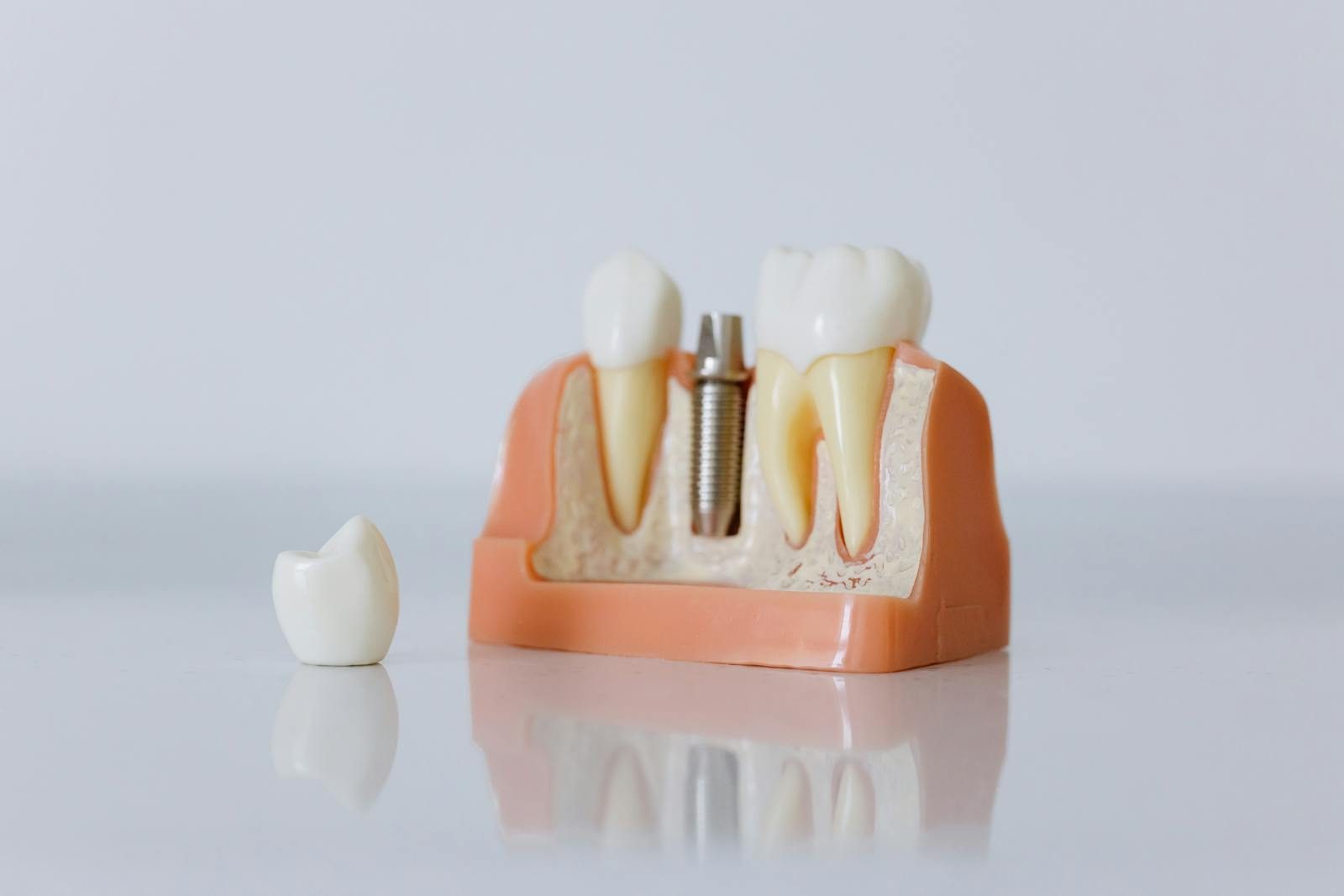
A dental implant is a small titanium screw surgically placed into your jawbone, acting as a replacement for the root of a missing tooth. Over the following months the implant integrates with your bone in a process called osseointegration, creating a stable foundation for the tooth that sits on top.
It helps to be clear from the outset that an implant is not a single object — it’s a system of three parts, each fitted at a different stage and each priced separately.
- The fixture — the titanium screw, placed into the jaw at the surgical stage. From £1,250.
- The abutment — a small connector that screws into the fixture once integration is complete. From £250.
- The crown — the visible, custom-made tooth on top, matched in colour and shape to your existing teeth. From £1,250.
So a single-tooth case typically totals £2,750 and upward once all three components are fitted. We mention this up front because some practices quote only the fixture price and let patients discover the additional charges later — that’s not our approach. The full breakdown is in the pricing section below and on our fees page.
We use Ankylos implants (made by Dentsply Sirona) — one of the most established implant systems in the world, with decades of published clinical research behind it. That matters practically: any dentist anywhere in the country, now or in twenty years, can service your implant if you ever move away from Edgware.
Why patients choose implants over the alternatives
Most patients arrive on this page weighing four options: an implant, a bridge, a denture, or leaving the gap. Each has its place, but for most healthy adults with a single missing tooth an implant is the option we genuinely recommend most often.
Versus a bridge
A traditional bridge anchors a false tooth to crowns on the teeth either side. Those neighbouring teeth have to be filed down — even if otherwise pristine — and they then need crown coverage for the rest of their lives. An implant solves the same problem without touching the neighbours. Where the adjacent teeth already need crowns, a bridge can still be the right call (we cover that decision on the bridges page), but for an isolated missing tooth between two healthy ones, an implant is the more conservative answer.
Versus a denture
Partial dentures are removable. They sit on the gum, clip onto the remaining teeth, and have to come out at night for cleaning. Patients who have lived with a denture often describe a low-level awareness of it being there — the slight movement, the occasional click. An implant is fixed in the bone, doesn’t come out, and you forget it is there within weeks of fitting.
Versus leaving the gap
The most common option, and the one we’d push back on most strongly. The jawbone needs the stimulation of a tooth root to maintain its volume — without that stimulus, the bone under the gap gradually shrinks. Over five to ten years the change becomes visible: the gum line collapses, the cheek over the gap can hollow slightly, and the neighbouring teeth drift into the empty space, taking the bite out of alignment. Of the realistic tooth-replacement options, an implant is the one that stops bone loss properly, because it stimulates the bone the way a natural root would.
The implant process at Campos Dental
Implant treatment runs across several distinct stages over three to six months for a routine case. Cases involving a bone graft or sinus lift add several months at the start.
Consultation and 3D planning
Your first visit combines an unhurried conversation with a thorough clinical exam, digital X-rays and — where clinically needed — a CBCT scan. The CBCT is included as part of your implant treatment plan when needed; it is not an extra charge for implant patients. We use the scan to measure bone height and width at the planned site, identify nearby anatomy (sinus above, nerve below), and plan the implant position digitally before any surgery is booked. If a graft or sinus lift will be needed, we identify that here, not on the day.
Placement
The implant fixture is placed under local anaesthetic — the same numbing used for a filling. A small incision in the gum gives access to the bone, a precise channel is prepared, and the titanium fixture is screwed into position. The gum is stitched back over and you go home the same day. Most patients return to work the next day. Some swelling and mild bruising for two or three days is normal; significant pain is not, and over-the-counter painkillers handle the first 48 hours comfortably for the great majority.
For patients who are nervous about surgery, or for longer multi-implant cases, we can arrange IV sedation with a visiting anaesthetist — quoted per case (charged per surgical procedure and per hour) and discussed at consultation rather than added on the day.
Healing and osseointegration
The long part of the journey — three to six months while the bone genuinely fuses with the titanium surface of the implant. You feel nothing during this phase; it is a biological process happening quietly under the gum. You’ll see us briefly once or twice for healing checks. For front teeth where appearance matters, we can usually fit a temporary tooth on the day of placement so no patient at our Edgware practice has to be seen socially with a missing front tooth at any stage.
Abutment and crown
Once the implant is integrated, a small abutment is fitted and a digital impression is taken of the abutment and surrounding teeth. The crown is manufactured by our ceramist over two to three weeks, and bonded onto the abutment at the final fitting appointment. You leave that visit with a complete tooth that looks, feels and functions like the one you lost.
Your implant journey, visit by visit
Patients looking into dental implants in Edgware usually want two practical answers before anything else: how many appointments this involves, and how long they will be without a tooth. Here is the routine single-tooth timeline, from the first conversation to the day the crown goes on.
- Consultation and planning, 45 to 60 minutes. Examination, digital X-rays, a CBCT scan where clinically needed, and a written quote before you leave. Two to four weeks until the next visit, longer if you want time to think.
- Placement, 60 to 90 minutes. The fixture goes in under local anaesthetic, the gum is closed, and a temporary tooth is fitted where the gap shows when you smile. Most patients are back at work the following day.
- Healing check, 15 minutes, a week or two later. We look at the site, deal with any stitches and answer whatever has come up since.
- Abutment and scan, 30 minutes. This is the appointment on the far side of osseointegration, three to six months after placement. The abutment is fitted and a digital impression is taken for your crown.
- Crown fitting, 45 minutes, two to three weeks after that. The crown is tried in, adjusted, bonded and the bite checked. You leave with the tooth finished, and we see you again at a routine review six to twelve months later.
Five visits spread over three to six months is the routine picture. A bone graft or sinus lift adds one surgical appointment near the start and several months of healing before the fixture can go in. Multi-implant and full-arch cases run longer and are mapped out visit by visit at your consultation.
The stretch that worries people most, the three to six months of osseointegration, is the part that asks nothing of you at all. It happens quietly under the gum while you carry on as normal. Where the gap is visible when you smile, we fit a temporary tooth on the day of placement, so nobody has to spend those months with an obvious space.
Who are dental implants right for?
Most healthy adults are candidates, but a few factors change the conversation. We’ll discuss your specific situation at consultation and tell you honestly whether implants are sensible, sensible-with-modifications, or better avoided.
- Bone density and volume. The most common practical limit. Bone shrinks after tooth loss, and if too much time has passed there may not be enough left to anchor the implant securely. A CBCT scan tells us what we’re working with; where bone is insufficient, a graft or sinus lift can build the area up.
- Gum health. Active gum disease is a significant threat to a successful implant, because the same bacteria that drive gum disease around natural teeth can attack the tissue around an implant. We need the periodontal situation stable and well-controlled first.
- Smoking. Smoking roughly doubles the failure rate and slows healing. We don’t refuse smokers, but we’ll strongly encourage cutting down or stopping in the weeks before and after surgery.
- Diabetes. Well-controlled diabetes is generally compatible with implant treatment. Uncontrolled diabetes impairs healing — we may want to liaise with your GP before proceeding.
- Age. No upper age limit. We routinely treat patients in their seventies and eighties from across Edgware, Stanmore and Mill Hill. The lower limit is jaw maturity — we generally wait until growth is complete in late teens.
Common concerns
Will it hurt?
Less than most people expect. The surgery is done under local anaesthetic and patients feel pressure but not pain during the procedure. The 48 hours afterwards involve some swelling, occasional bruising, and a dull ache usually well-controlled with over-the-counter painkillers. Most of our Edgware implant patients tell us, after the event, that it was more comfortable than a difficult tooth extraction. For anxious patients we can arrange IV sedation via our visiting anaesthetist.
What if the implant fails?
Modern implant placement has a success rate of around 95% at 10 years for routine cases in healthy patients. The small percentage that fail tend to fail either early — within the first few months while integration is happening — or late, through peri-implantitis (gum and bone infection around the implant) years down the line. Early failures are managed by removing the implant, letting the site heal, and making a fresh attempt — often successfully. Late failures are largely preventable through good home cleaning and regular dental hygiene visits. We will always talk you through what failure looks like, rather than pretend it cannot happen.
Bone grafts and sinus lifts
Both build up bone volume where there isn’t quite enough to anchor an implant securely. A graft adds bone material at the site of the planned implant — most often alongside placement, without significantly extending treatment time. A sinus lift is a specific graft used in the upper back of the mouth, where the maxillary sinus sits close to the jaw. The CBCT scan tells us whether either is needed at the planning stage, so there are no surprises on the day.
Pricing and finance
We’ve always taken the view that quoted prices belong on a website, not hidden behind a consultation. Implants are the area where pricing transparency matters most, because the component-by-component structure of the treatment is easy to misunderstand. Here is the full breakdown for a single-tooth case at our Edgware practice — all figures start from these amounts, with the exact quote confirmed at consultation.
- Implant fixture (single tooth) — from £1,250
- Implant abutment — from £250
- Implant crown — from £1,250
- All-in single-tooth case — typically £2,750+
Additional items where clinically indicated:
- CBCT scan — included with your implant treatment plan when clinically needed (the £140 CBCT line item on our fees page applies to non-implant cases only).
- Bone graft — from £495 per site.
- Sinus lift — from £1,200.
- IV sedation — quoted per case via our visiting anaesthetist, charged per surgical procedure and per hour.
- Multi-implant and full-arch restorations — quoted individually after consultation, because the variables shift too much for a standard figure.
Inclusions footnote — From £1,250 covers placement of the implant fixture only. The abutment (from £250) and implant crown (from £1,250) are quoted separately, so a single-tooth implant case typically totals £2,750 or more. CBCT scans are included with your treatment plan where clinically needed. Bone graft (from £495), sinus lift (from £1,200) and IV sedation (quoted per case via our visiting anaesthetist) may be additional where indicated. Multi-implant cases and full-arch restorations are quoted individually after consultation.
We offer 0% finance via Chrysalis Finance, with loan amounts from £350 to £25,000 over up to twelve months at 0% APR, subject to status. For a £2,750 single-tooth case spread over 12 months that works out at around £229 a month — full details on the finance page.
Adult members of our dental plan receive 10% off the cost of treatment, and that discount applies to implants in full — Invisalign is the one exception across all our treatments. For patients planning a single implant in the coming year, joining the plan even briefly can be worthwhile — the £21.50 monthly subscription covers routine examinations and hygiene visits alongside the implant discount.
How long do implants last?
A well-placed implant in a well-maintained mouth routinely lasts 20 years and often longer. The 95% survival rate at 10 years cited in the wider clinical literature for routine cases broadly matches what we see in our own long-term patients. The biggest determinants of longevity are home cleaning, regular hygiene visits, and whether you smoke.
The crown that sits on top has a slightly different lifespan to the fixture underneath — porcelain can chip and crowns may need replacing every fifteen years or so even when the implant fixture below is still sound. Replacing a crown on an existing implant is a much simpler piece of work than replacing the implant itself.
Aftercare
Implants don’t get decay, but the gum and bone around them can become inflamed or infected if home care slips — a condition called peri-implantitis. Good aftercare is straightforward.
- Brush twice daily with a soft or medium toothbrush and a fluoride toothpaste, paying particular attention to the gum line around the implant crown.
- Floss or use interdental brushes daily. A small Tepe brush, sized to fit the gap, is often easier than floss around an implant.
- A water flosser (Waterpik-style) is a useful adjunct, particularly for implant bridges or full-arch cases.
- Hygiene visits every six months — included in our adult dental plan. The hygienist uses specific instruments designed for implant surfaces.
- Don’t ignore bleeding around an implant. Bleeding, swelling or tenderness is the early sign of peri-implantitis and is much easier to treat early than late.
Call us promptly if the crown ever feels loose or rotates, if there is bleeding or swelling around the gum line that doesn’t settle within a few days, or if you notice a persistent dull ache or bad taste around the implant. None of these mean the implant has failed — most have straightforward fixes if caught early.
Implants vs other tooth-replacement options
A side-by-side comparison of the three realistic options for replacing a missing tooth. None is universally right; the right answer for your case depends on the position of the gap, the health of the neighbouring teeth, the bone underneath, and your budget and timeline.
| Factor | Dental implant | Conventional bridge | Partial denture |
|---|
| Fixed or removable? | Fixed | Fixed | Removable |
| Affects neighbouring teeth? | No | Yes — neighbours filed down for crown coverage | No drilling — but clasps rest on neighbours |
| Preserves jawbone? | Yes — fixture stimulates bone like a natural root | No — bone under the pontic still shrinks | No — bone under the gap still shrinks |
| Typical lifespan | 20+ years for the fixture; crown 15+ years | 10–15 years, sometimes longer | 5–10 years before relining or remake |
| Starting price | from £2,750 (fixture + abutment + crown) | from £900–£995 | from £550 |
| Treatment time | 3–6 months | 2 appointments over ~2 weeks | 4–6 weeks |
| Most suited to | Healthy patients with good bone wanting a long-lasting, fixed replacement | Cases where neighbouring teeth already need crowns | Multiple missing teeth, budget-led cases, interim solutions |
Dental implant
- Fixed or removable?
- Fixed
- Affects neighbouring teeth?
- No
- Preserves jawbone?
- Yes — fixture stimulates bone like a natural root
- Typical lifespan
- 20+ years for the fixture; crown 15+ years
- Starting price
- from £2,750 (fixture + abutment + crown)
- Treatment time
- 3–6 months
- Most suited to
- Healthy patients with good bone wanting a long-lasting, fixed replacement
Conventional bridge
- Fixed or removable?
- Fixed
- Affects neighbouring teeth?
- Yes — neighbours filed down for crown coverage
- Preserves jawbone?
- No — bone under the pontic still shrinks
- Typical lifespan
- 10–15 years, sometimes longer
- Starting price
- from £900–£995
- Treatment time
- 2 appointments over ~2 weeks
- Most suited to
- Cases where neighbouring teeth already need crowns
Partial denture
- Fixed or removable?
- Removable
- Affects neighbouring teeth?
- No drilling — but clasps rest on neighbours
- Preserves jawbone?
- No — bone under the gap still shrinks
- Typical lifespan
- 5–10 years before relining or remake
- Starting price
- from £550
- Treatment time
- 4–6 weeks
- Most suited to
- Multiple missing teeth, budget-led cases, interim solutions
The most important factor in the long-term result is which option matches your specific situation — and we’ll always honestly recommend the option that fits, rather than the one that’s most profitable.
Considering implants?
All treatment plans start with a check-up. Book yours online at our Edgware practice — we’ll examine the gap, take any imaging we need to plan properly, talk you through the options for your specific case, and only recommend treatment if it is genuinely right for you. If a bridge or a denture turns out to be the better answer, we will say so.
If you’d rather speak to us first, get in touch — we’re happy to answer questions on the phone before you commit to a visit. Many of our implant patients come from across Edgware, Stanmore, Mill Hill and the surrounding areas.
Further reading from the blog