
3D Dental Scans in Edgware: How CBCT Imaging Improves Your Treatment
Cone Beam CT (CBCT) lets us see teeth, bone, nerves and sinuses in three dimensions at a fraction of the radiation dose of a medical CT, supporting more accurate diagnoses and safer treatment planning. Here's how the scan works, what it costs, when you need one, and the radiation context.
- technology
- imaging
- diagnosis
- implants
- patient guide
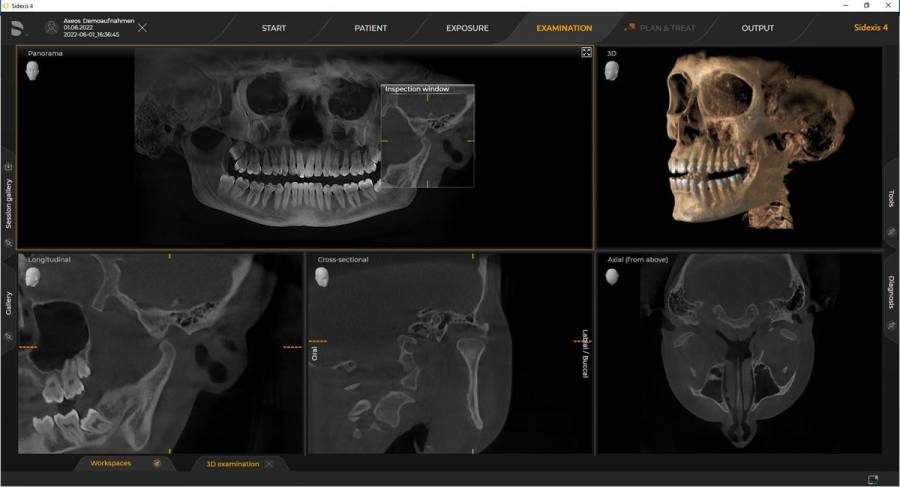
At Campos Dental in Edgware we use Cone Beam Computed Tomography (CBCT) to support diagnoses and treatment planning that a conventional 2D X-ray cannot. The scan takes around twenty seconds, delivers far more anatomical detail than a sequence of intraoral X-rays, and uses a fraction of the radiation dose of a medical CT. This post explains what a CBCT actually does, who needs one, what it costs, and the radiation safety context.
What is a 3D dental scan?
A 3D dental scan captures imagery from multiple angles in a single session, building a complete anatomical model of the area we’re looking at. Unlike a standard X-ray that gives a flat, two-dimensional picture, the CBCT scan lets us see the relationships between tooth roots, sinus floors, nerve canals and surrounding bone. These are the things that matter when we’re planning anything more complex than a filling.
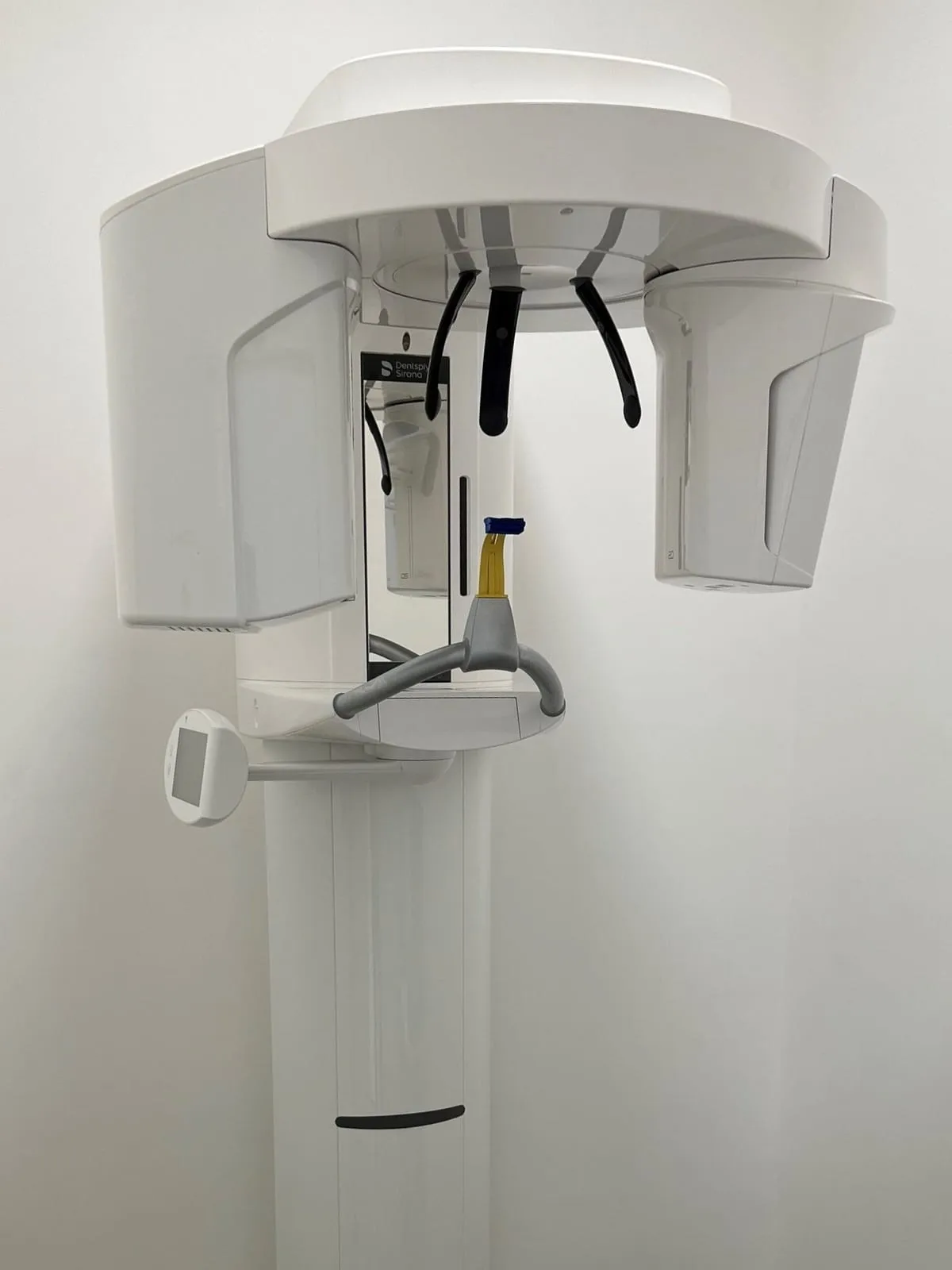
The CBCT unit at Campos Dental. The patient stands or sits with their head positioned between the rotating arm; the whole scan completes in under twenty seconds at a fraction of the radiation dose of a medical CT.
How the scan actually works
A medical CT scan rotates a fan-shaped X-ray beam through your body many times and stacks the slices into a 3D image. The radiation dose is high because it has to penetrate the whole torso.
A CBCT does the equivalent for the head and jaw using a cone-shaped beam that captures the entire region in a single rotation. The detector is far smaller, the radiation field is far smaller, and you stand or sit comfortably with your head positioned between the rotating arm. The whole scan is over in under twenty seconds; the resulting dataset gives us a full 3D model we can rotate, section and measure on-screen.
Benefits of 3D X-ray imaging for patients
1. Accurate diagnosis
CBCT identifies issues that standard radiography can miss: small fractures, hidden infections at the root tip, additional root canals in molars, root anomalies, lesions in the bone. That means we can act earlier, while problems are still small.
2. Precise treatment planning
For dental implants, complex root canal treatment, orthodontic planning, and certain restorative cases, the difference between 2D and 3D is the difference between guessing and measuring. We see where the bone is, where the nerves run, where the sinus floor sits, and exactly how teeth occupy the jaw, which translates directly into more predictable outcomes.
3. Lower radiation than sequential 2D X-rays
A dental CBCT for a single arch delivers roughly 0.05 mSv, equivalent to a few days of natural background radiation, and about 1–5% of the dose of a medical head CT. Where a single CBCT replaces multiple 2D X-rays that would otherwise be needed for the same planning, the total dose is often lower with the CBCT than without.
For context, the average UK background radiation exposure is around 2.7 mSv per year. A return transatlantic flight contributes around 0.1 mSv. A CBCT scan delivers around 0.05 mSv.
4. Clear patient communication
We can show you the 3D scan on-screen during your consultation. Seeing your own anatomy (the actual nerve canal sitting under the molar we’re planning to extract, the exact bone available for an implant) makes diagnoses easier to understand and treatment options easier to weigh. Far more intuitive than trying to interpret a small grey-scale film.
5. Less invasive procedures
Three-dimensional mapping lets us plan treatments with greater accuracy, which often translates into less invasive procedures, faster healing and improved comfort. Implant placement guided by CBCT planning, for example, can sometimes avoid the need for a bone graft because we know in advance exactly where the bone is.
Who needs a CBCT scan?
Not every patient. We only recommend a CBCT when the additional 3D information would meaningfully change diagnosis or treatment planning. The most common indications:
- Dental implants: to confirm bone volume and density, locate the inferior alveolar nerve in the lower jaw, and locate the sinus floor in the upper jaw. See our dental implants page for the full implant pathway.
- Complex root canal treatment: to identify additional canals (particularly in upper molars) and assess root anomalies. Root canal treatment ›
- Orthodontic planning: to assess unerupted teeth, root positions and skeletal relationships before more involved treatment. Orthodontics ›
- Wisdom-tooth surgical planning: to assess proximity to the nerve and the technical complexity of removal.
- Suspected jaw pathology: cysts, lesions, suspected fractures.
- TMJ assessment: where joint anatomy is relevant to splint or referral planning. TMJ ›
If a 2D X-ray is sufficient (and for routine fillings, hygiene visits, simple extractions, and most general dentistry it is), we don’t take a CBCT. The principle is “as low as reasonably achievable”, and the CBCT is reserved for cases where the additional information genuinely matters.
What it costs
CBCT scans at Campos Dental start from £140 for a focused single-arch scan, with larger fields of view priced accordingly. The scan is included with implant treatment when clinically required: the published implant fee assumes a CBCT in the planning stage. The full fee guide has every figure.
Who reads the scan
The scan is acquired by our clinical team and interpreted by the clinician planning your treatment. For most cases that is Dr Jacqueline Jacobs (GDC 155186). Where a scan picks up something outside our area of expertise (an incidental finding in the sinus, a jaw lesion that warrants specialist review) we refer to the appropriate specialist with the scan dataset for their review.
Frequently asked
Is a CBCT scan safe?
Yes. The dose is approximately 0.05 mSv per scan. That is equivalent to a few days of natural background radiation. We only recommend a CBCT when the 3D information would meaningfully change the diagnosis or treatment plan; we don’t take them routinely.
Will I feel anything during the scan?
No. The CBCT is non-contact: you stand or sit still with your head positioned between the rotating arm and the scan is over in under twenty seconds. No injection, no taste, no physical sensation. You’ll hear a soft mechanical whir as the arm rotates.
Do I need a CBCT before a filling or a routine check-up?
No. Routine restorative work and check-ups are planned from clinical examination plus a small intraoral X-ray where indicated. CBCT is reserved for the cases where it changes the plan.
What if the scan finds something unexpected?
We’ll explain it, show you on the screen, and recommend the appropriate next step. If it’s something outside our scope (a sinus finding, for example) we refer you to a specialist with the scan dataset attached. We won’t quietly proceed with anything that wasn’t part of the original plan.
Can I have a copy of the scan?
Yes, on request. Usually on a USB stick, or via secure transfer to a specialist if you’re being referred. The full dataset is yours.
If you’d like to see the CBCT setup, or you’re considering treatment where a 3D scan might help, get in touch. We’re at 70 Edgware Way, Edgware HA8 8JS.
— Dr Jacqueline Jacobs
Find us in Edgware.
Free 30-minute parking out front and a step-free entrance. Pop in for a look or call ahead — we usually answer within a few rings.
Campos Dental
70 Edgware Way
Edgware, HA8 8JS
Call us
020 3971 2000Contact us
Send us a message →Opening hours
- Mon – Fri 9:00 am – 5:30 pm (closed 1–2 pm)
- Sat by appointment
- Sun closed
Questions about your situation?
If anything in this article applies to you and you'd like to talk it through, give us a call.
Book Online opens in our secure Dentally Portal — verified by SMS. All treatment plans start with a check-up.