Typical lifespan
- Small composite filling
- 7–15 years
- Large composite filling
- 5–10 years
- Lab-made inlay
- 10–15 years
- Onlay
- 15+ years
- Ceramic crown
- 15+ years (often 20+)
- Metal crown
- 20+ years
Fillings from £100, crowns from £550. Why dentists sometimes recommend the bigger restoration, the onlay middle ground between the two, and the honest prices for each option.
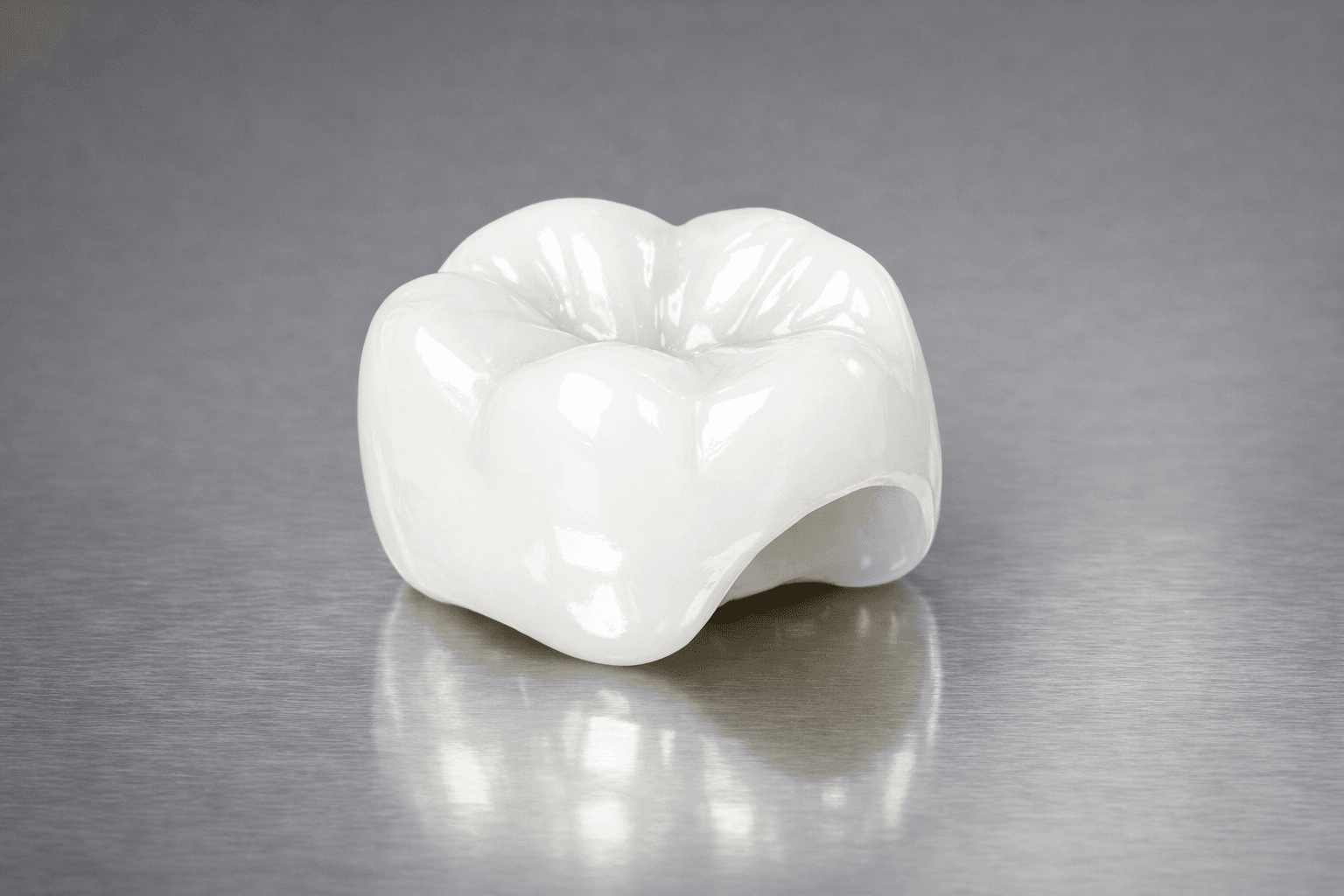
“Why can’t you just put a filling in?” is a question we hear when we’ve recommended a crown. It’s a reasonable question. Fillings are cheaper, faster, less invasive, and most patients have had several of them. The answer comes down to how much tooth is left, and a piece of biomechanics that isn’t always obvious from the patient’s side of the chair.
This post explains how we make that decision, the middle-ground options between a filling and a full crown, and the prices for each.
Roughly:
The percentages aren’t an exact science; the location matters (front teeth take very different forces from molars), the patient’s bite matters, and the quality of the remaining tooth matters. But “how much tooth is left” is the heart of it.
A tooth is a fundamentally hollow structure. The hard outer enamel and dentine form an arch, and the cusps act like the legs of a small bridge. When you bite down, the forces are distributed around the arch. The tooth doesn’t fail because the load is shared by the structure as a whole.
A small filling doesn’t change this: it occupies a void without disrupting the arch. A large filling, however, replaces so much of the structural shell that the remaining tooth becomes a thin wall trying to bear all of the load alone. Under repeated chewing pressure (which can be 30–60 kg of force per square cm), thin walls of tooth crack. Often vertically, often unpredictably, and often deeper than the original damage. We see this regularly: a tooth with a large filling that fractures and is suddenly unrestorable.
A crown solves the problem by wrapping the tooth and redistributing the load. The crown carries the chewing force; the remaining tooth structure just sits underneath, protected.
This is why your dentist is sometimes more cautious than you’d expect with large restorations. “Can’t you just put a filling in?” We could, but if it fails in a year and takes the rest of the tooth with it, you’ve paid for a filling and lost the tooth. A crown placed now keeps the tooth.
When we’re choosing between a filling, an onlay, and a crown, we’re thinking about:
We make the call once the damage is fully exposed. If we tell you at the assessment that you “might need a crown”, and the actual cavity is smaller than the X-ray suggested, we’ll do a filling instead and not charge you for the crown. The reverse can also happen.
For small-to-medium cavities. A composite filling is bonded to the tooth structure rather than just mechanically retained, which means it works with less remaining tooth than the old silver amalgam fillings did. Modern composites are durable, aesthetic, and last 7–15 years in most patients. See our general dentistry treatment page for more.
Where the cavity is larger than ideal for a direct filling but doesn’t yet need a crown, a lab-made composite inlay is a good intermediate. We take an impression, the lab fabricates a piece that fits the cavity exactly, and we bond it in at the next appointment. More precise than a direct filling for larger restorations, and protects the underlying tooth structure better.
Covers one or more cusps of the tooth without going all the way around. Less invasive than a full crown, more protective than a filling. We use these when one cusp has fractured but the rest of the tooth is sound.
When the tooth needs full coverage. Modern ceramic crowns (we typically use lithium disilicate / e.max for visible teeth, zirconia for back teeth) are aesthetically excellent and structurally strong. The tooth is prepared down to a specific shape, an impression taken, and the crown bonded or cemented at the next appointment.
For back molars where aesthetics don’t matter and the bite forces are highest, a metal crown can be the right answer. Slimmer than ceramic (less tooth needs to be removed) and extremely durable. Less common now but still appropriate for certain cases. We’ll discuss it if it’s a sensible option for you.
| Restoration | Typical lifespan |
|---|---|
| Small composite filling | 7–15 years |
| Large composite filling | 5–10 years |
| Lab-made inlay | 10–15 years |
| Onlay | 15+ years |
| Ceramic crown | 15+ years (often 20+) |
| Metal crown | 20+ years |
These are typical figures, not guarantees. Diet, hygiene, grinding, and bite all affect longevity. A patient with excellent hygiene who doesn’t grind their teeth may have a crown that lasts 30 years. A patient with active reflux and unmanaged bruxism may need to replace one in 5.
Most crown decisions involve replacing an old, large filling that’s started to fail: a crack, recurrent decay at the margin, a piece breaking off. The temptation is to do “another, larger filling”. Sometimes that’s the right answer, but if the underlying tooth has reached the point where each successive filling is bigger than the last, the trajectory is towards eventual loss of the tooth. A crown breaks the cycle.
We’ll always tell you when we think a filling is fine and when we think a crown is needed. We’ll show you the X-ray and explain what we’re seeing. If you’d prefer to take the smaller-intervention route now and revisit if it fails, we’ll respect that, provided it’s a clinically defensible option. Where it isn’t (visible cracking, cusps already lost), we’ll be honest that the smaller restoration is likely to fail relatively soon.
A crown can also be planned in advance even if your existing filling is intact today. Sometimes the right answer is “let’s keep an eye on it and crown it before it breaks”. A pre-emptive crown costs the same as a reactive one but doesn’t involve the emergency appointment, the antibiotics, or the temporary that goes with a fractured tooth.
Treatment fees are published in full on the fee guide, and larger cases can be spread over 12 months at 0% APR through Chrysalis Finance.
Yes. If you have a large filling today and we agree to monitor, a crown can be placed whenever it becomes the right time: when the filling starts to fail, when you notice sensitivity, or simply when you’d prefer the more durable option. The crown procedure itself is the same whether the tooth has had previous fillings or not.
Not necessarily. Most crowns we place are on vital (live) teeth that have lost too much structure for a filling but where the nerve is healthy. Root canal treatment is needed when the nerve itself is involved, whether through deep decay, fracture into the pulp chamber, or pain that indicates pulpal inflammation. Sometimes a tooth that needs a crown also needs a root canal; sometimes it doesn’t.
For a routine case: one 60–90-minute appointment to prepare the tooth and take the impression, then a 30-minute appointment 2–3 weeks later to fit the final crown. You’ll have a temporary crown in between. It’s comfortable, functional for eating soft food, and removable when the final crown is ready.
The whole procedure is done under local anaesthetic. You’ll feel pressure (and the vibration of the high-speed handpiece) but no pain. The most uncomfortable bit for most patients is the impression material setting for a minute or two; we use a digital scanner where possible to skip that step.
Occasionally, particularly older crowns where the cement has degraded over years. If a crown comes off cleanly, bring it in with you. Usually we can clean and re-cement it the same day (re-cement crown / inlay £100). If the underlying tooth has fractured, a new crown may be needed.
If you’ve been told a tooth needs a crown and you’d like a second opinion or just a clearer explanation of why, get in touch. We’d be happy to look honestly and walk through the decision with you.
— Dr Jacqueline Jacobs
Free 30-minute parking out front and a step-free entrance. Pop in for a look or call ahead — we usually answer within a few rings.
Campos Dental
70 Edgware Way
Edgware, HA8 8JS
Call us
020 3971 2000Contact us
Send us a message →Opening hours
If anything in this article applies to you and you'd like to talk it through, give us a call.
Book Online opens in our secure Dentally Portal — verified by SMS. All treatment plans start with a check-up.
Open Mon – Fri · 9:00 am – 5:30 pm (Closed 1–2 pm)
Most computers can't place the call — copy the number to dial on your phone, or: