Mouth Cancer Screening: What We Look For at Every Check-Up
Mouth cancer cases in the UK have doubled in twenty years and survival depends overwhelmingly on early detection. Here's what we screen for at every routine examination, what to watch for between visits, and what to do if you find something.
- mouth cancer
- preventative
- patient guide
- screening
- oral health
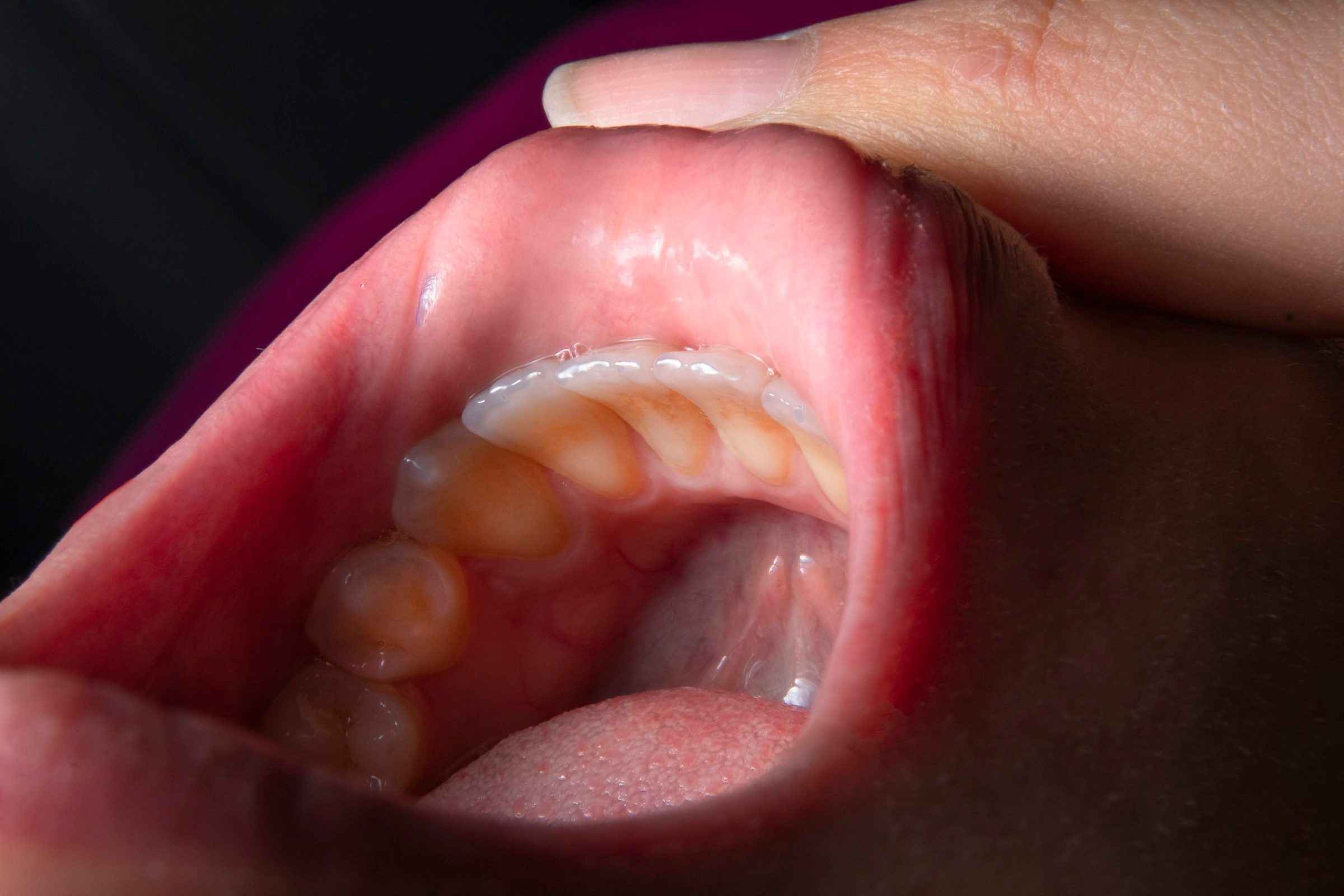
This post deals with a serious topic gently. Mouth cancer (head-and-neck cancer affecting the mouth, tongue, throat, lips and salivary glands) has roughly doubled in UK incidence over the last twenty years. In 2024, around 8,800 new cases were diagnosed in the UK; survival depends overwhelmingly on how early it’s caught. Five-year survival exceeds 80% when caught at Stage 1; it falls below 30% at Stage 4.
The single most useful thing you can do to reduce your risk of dying from mouth cancer is to be screened regularly. At Campos Dental, oral cancer screening is part of every routine examination, with no additional charge, regardless of whether you’re on a plan or pay-as-you-go. This post explains what we actually look for, what to watch for between visits, and what to do if you find something.
Who is at higher risk
Risk factors aren’t deterministic, and many patients with mouth cancer have no known risk factors. But the following are well-established:
- Tobacco in any form, including smoking, chewing tobacco, and shisha
- Alcohol: risk rises with consumption, and the combination of tobacco and alcohol multiplies the risk well beyond either alone
- Human papillomavirus (HPV): increasingly associated with oropharyngeal cancer, particularly in younger non-smokers
- Age: most cases are in patients over 55, though numbers under 55 are increasing
- Sun exposure for lip cancer specifically, relevant to outdoor workers
- Previous mouth cancer or a strong family history
- Chronic poor oral hygiene: likely an associated rather than causative factor
- Some dietary factors, particularly low intake of fresh fruit and vegetables
If any of those apply to you, please make sure you’re seeing a dentist routinely. If you smoke and drink, the case for not skipping check-ups is genuinely strong.
What we examine at every routine check-up
Every Campos Dental routine examination includes a structured soft-tissue and oral-cancer screening. We’re looking systematically at:
- Lips: outer surface (sun damage, lumps), inner surface, lip line
- Cheeks (buccal mucosa): inside of both cheeks, the area where cheek meets gum
- Floor of the mouth: under the tongue, where many tumours start because patients can’t see this area themselves
- Top, sides, and underside of the tongue: we ask you to stick your tongue out, then to lift it, then we gently move it to each side with a piece of gauze
- Gums and the area where the gums meet the teeth
- Hard palate (roof of the mouth) and soft palate
- The back of the throat, including the tonsils and the soft palate as it descends
- Lymph nodes: we feel the nodes in the neck and under the jaw with our fingertips to check for any swelling or unusual texture
This takes a few minutes at every check-up. Most patients don’t realise they’re being screened because the examination is unremarkable when nothing is wrong, which is by far the most common outcome.
What we’re looking for
The signs that warrant further investigation are:
- A white patch (leukoplakia) or red patch (erythroplakia) that doesn’t rub off and has been there more than three weeks. Red patches are statistically more concerning than white.
- An ulcer that hasn’t healed after three weeks. Most mouth ulcers heal in 7–14 days. Persistence past three weeks is the threshold for concern.
- A lump or thickening in the mouth or on the lip
- A persistent rough or crusty patch
- A lump in the neck that hasn’t gone away
- Difficulty swallowing or persistent hoarseness lasting more than three weeks
- Numbness in the lip, tongue, or chin without a clear cause
- A tooth that becomes loose for no clear reason
- Unexplained pain or tenderness in a localised area
None of these signs mean cancer. Most of them have entirely benign causes (a bitten cheek, a poorly-fitting denture, a viral ulcer, a salivary stone). But the same signs are also the early presentation of cancer, and the three-week threshold is the rule of thumb for when “watch and wait” becomes “have it looked at”.
What to watch for between visits
You see your own mouth more often than we do. The simple self-check, once a month:
- Stand in front of a mirror with good light
- Look at the outside of your lips, gently pulling the corners
- Pull each cheek out and look at the inside surface
- Stick your tongue out, look at the top, then lift it and look underneath
- Tilt your head back and look at the roof of your mouth, then open wide and check the back of your throat
- Run your finger along your gums and the inside of your cheeks, feeling for anything unusual
- Feel the sides of your neck and under your jaw for any new lumps
Anything that’s been there more than three weeks and isn’t getting better: book an appointment. Don’t wait for your next routine check-up.
What we do if we find something
If we see or feel something at an examination that warrants further investigation, the pathway is:
- A clear conversation with you about what we’ve found, what it might be, and what the next step is. We’ll show you the area with a small mirror.
- A referral letter to the local hospital’s oral and maxillofacial surgery department, sent the same day, marked “two-week wait” under the NHS urgent suspected cancer pathway. This guarantees you an appointment with a specialist within two weeks.
- A follow-up call from us a few days later to check the appointment is in the diary.
The two-week-wait pathway is specifically for urgent suspected cancer. Most patients referred via this pathway do not turn out to have cancer, but the system is designed so that anything that might be is seen quickly. You don’t pay anything for the referral or for the hospital appointment.
If you don’t have a GP or can’t access NHS services, please tell us at the appointment. We can refer to a private specialist if that’s appropriate.
Mouth cancer in younger patients and HPV
Twenty years ago, mouth cancer was overwhelmingly a disease of older smokers and heavy drinkers. That’s changing. The fastest-growing group is patients under 55 with HPV-associated oropharyngeal cancer, typically at the base of the tongue or in the tonsils, many of whom have no history of tobacco or significant alcohol use.
HPV vaccination (offered to UK schoolchildren) is expected to reduce these numbers over the next twenty years. For adults who weren’t vaccinated, the practical advice is the same: come for routine screening, and if anything in your mouth or throat doesn’t heal in three weeks, get it checked.
”Can I just ask to be screened?”
Yes, but you don’t need to. Mouth cancer screening is part of every routine examination at Campos Dental. If you’ve been worried about a specific area or symptom and you’d like us to focus on it, please mention it when you book. We’ll allow extra time and look carefully.
For new patients, the new-patient examination (£65) includes a thorough soft-tissue screening. For existing patients, the routine examination (£50) does. The adult plan at £21.50 / month includes two examinations a year, meaning you’d be screened twice annually as part of standard care.
A word about smoking and drinking
If you smoke and drink, you have the single largest modifiable risk factor for mouth cancer. We are not going to lecture you. We will, at every check-up, mention it briefly and ask if support to cut down would be helpful, because that’s our clinical responsibility. We have referral routes to local NHS smoking cessation services and we’d be glad to give you the contact.
Reducing smoking, even without stopping, reduces mouth cancer risk. Stopping reduces it substantially. It is genuinely worth doing.
Frequently asked
How often should I be screened?
If you have no specific risk factors, the screening at your routine six-monthly examination is sufficient. Patients with higher risk (smokers, heavy drinkers, previous mouth cancer history) may benefit from a screening every 3–4 months. We’d suggest this individually where it applies.
Does the screening hurt?
No. It’s a visual and gentle palpation examination. We touch the lymph nodes in your neck firmly enough to feel through the skin but not enough to be uncomfortable. The tongue manipulation can feel slightly odd if you have a strong gag reflex but it’s brief.
What if you find something?
We explain it, refer you to the appropriate specialist via the two-week-wait pathway, and follow up. We’re not the people who biopsy or treat mouth cancer; that’s hospital specialists. Our role is to spot it early and get you to the right person.
Are dental X-rays used for cancer screening?
No, not specifically. Standard dental X-rays show teeth and bone, not soft tissue. Mouth cancer screening is a clinical examination: eyes, fingers, and good light. CBCT scans are sometimes useful for jaw lesions but the primary screen is always the clinical examination.
I have a white patch that comes and goes. Should I worry?
A white patch that resolves and recurs over a few days is usually a minor irritation (a bitten cheek, a stress ulcer, a viral infection). A white patch that has been continuously there for more than three weeks should be examined, whether or not it’s painful.
If you’ve noticed anything that’s been there more than three weeks, please get in touch or call us on 020 3971 2000. We’d much rather see you and reassure you it’s nothing than have you wait.
— Dr Jacqueline Jacobs
Find us in Edgware.
Free 30-minute parking out front and a step-free entrance. Pop in for a look or call ahead — we usually answer within a few rings.
Campos Dental
70 Edgware Way
Edgware, HA8 8JS
Call us
020 3971 2000Contact us
Send us a message →Opening hours
- Mon – Fri 9:00 am – 5:30 pm (closed 1–2 pm)
- Sat by appointment
- Sun closed
Questions about your situation?
If anything in this article applies to you and you'd like to talk it through, give us a call.
Book Online opens in our secure Dentally Portal — verified by SMS. All treatment plans start with a check-up.