Tooth Extraction in Edgware: What the Appointment Actually Involves
If we've told you a tooth has to come out, or you suspect one might need to, here's exactly what happens at the appointment, what it feels like, what it costs, and how to recover quickly. Honest detail, no surprises.
- extractions
- surgery
- patient guide
- recovery
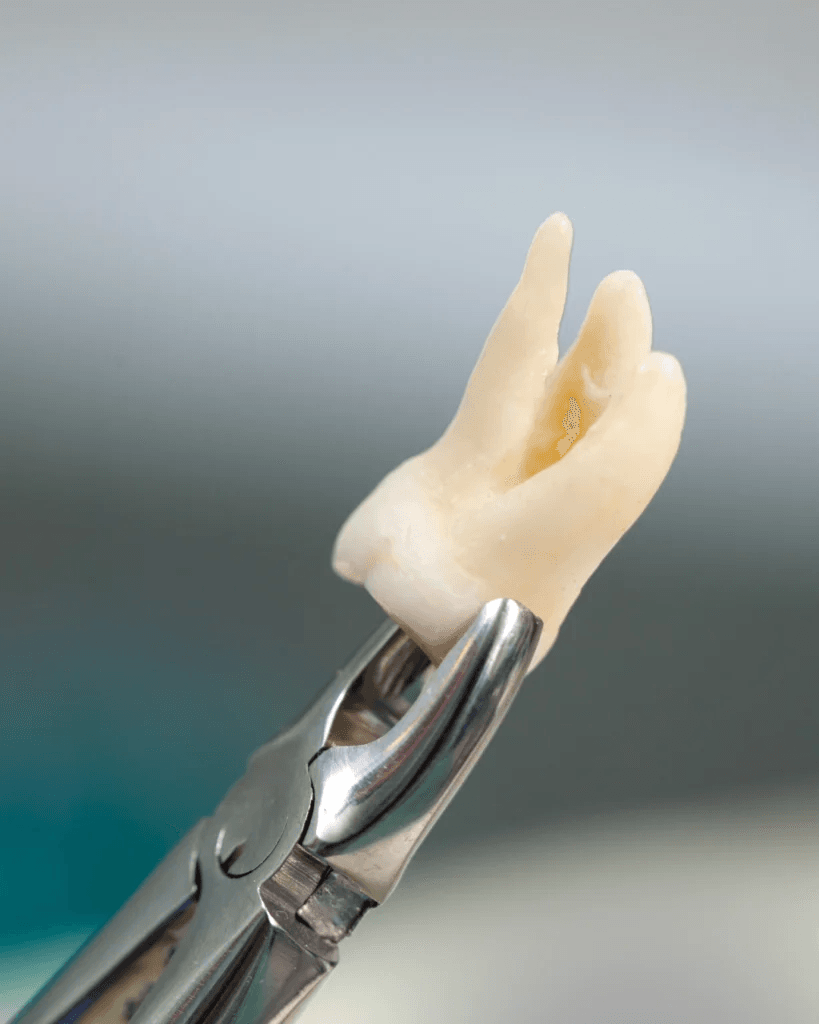
Most patients arrive at the extraction conversation already nervous. The mental image is usually worse than the procedure. Modern local anaesthetic and gentle technique mean that what you’ll actually feel is pressure, not pain. This post walks through what an extraction appointment at Campos Dental involves, how we decide it’s the right call, and what the next week looks like.
For what to do right now if something has just happened to your mouth, see our emergency dental guide. This post is about the planned extraction itself.
When extraction is the right call
We don’t extract a tooth just because it’s damaged. A tooth that can be saved with a root canal and a crown is almost always worth saving: your own root in your own bone is biologically and biomechanically better than any replacement. We recommend extraction when one of the following applies:
- The tooth is structurally beyond restoration. Decay or fracture extending below the bone, or so much tooth substance lost that no crown can be retained.
- A root canal isn’t viable. Complex root anatomy, prior failed endodontic treatment, or a vertical root fracture.
- Advanced periodontal disease has destroyed the supporting bone. A tooth held in soft gum tissue with a millimetre of bone left is a source of chronic infection.
- A wisdom tooth is causing problems. Repeated infections (pericoronitis), damage to the tooth in front, or significant impaction. If it isn’t causing trouble, we generally leave it alone.
- Crowding ahead of orthodontic treatment. Occasionally we’ll recommend extractions to create space, planned with the orthodontist.
If we’re recommending extraction we’ll explain why in plain terms, show you the X-ray or CBCT, and walk through the alternatives we considered. You don’t have to decide on the spot.
What the appointment actually involves
A planned extraction at Campos Dental typically takes 30–45 minutes. The steps:
- Pre-op chat. We’ll re-confirm the tooth, the plan, and answer any last-minute questions. You can change your mind at this point; we’ll never proceed without your agreement.
- Local anaesthetic. A small numbing gel first, then the injection itself. You’ll feel a brief sting, then numbness spreading over a few minutes. We wait until the area is profoundly numb before starting. There is no good reason to rush this part.
- Loosening the tooth. This is where most patient anxiety comes from, and where most patients are surprised at how little they feel. We use a fine instrument called an elevator to gently widen the socket and break the tiny fibres that hold the tooth to the bone. You’ll feel pressure and movement, no pain.
- Removal. Once the tooth is loose enough, gentle forceps take it out. Often just seconds. We will be talking you through what’s happening.
- The socket. We check that the entire tooth has come out, remove any soft tissue at the base of the socket, and place gauze for you to bite on. The bleeding stops quickly.
- Aftercare instructions. Written and verbal. You’ll know what to do for the next 24 hours before you leave the chair.
Simple vs surgical extraction
A simple extraction is removal of a tooth whose crown is intact and accessible: straightforward, from £150. The fee covers the anaesthetic, the procedure itself, and the post-op review if you need one.
A surgical extraction is needed when the tooth is broken at gum level, partially impacted, or has unusually curved roots. We make a small incision in the gum to gain access and may section the tooth for easier removal. From £350. Recovery is slightly longer but the procedure itself feels much the same. Anaesthetic does its job either way.
Wisdom teeth, lower molars with curved roots, and broken-down upper premolars near the sinus are the cases most likely to be surgical. We’ll tell you which category you’re in before we start.
For anxious patients: sedation
For patients with significant dental anxiety, or for longer multi-tooth cases, we can arrange IV sedation with a visiting anaesthetist. You’re conscious and able to follow instructions but profoundly relaxed; most patients describe the appointment afterwards as having passed in a few minutes. Quoted per case. More on dental anxiety ›
The first 24 hours
The first day is the one that matters most:
- Bite on the gauze for 30 minutes without checking. A stable blood clot forms in the socket. That clot is the foundation of healing and you do not want to disturb it.
- No rinsing, spitting or drinking through a straw for 24 hours. All of these can dislodge the clot. If you need to clear your mouth, gently let saliva fall into a sink rather than spitting.
- No smoking for at least 48 hours, ideally longer. Smoking dramatically increases the risk of dry socket and slows healing.
- No alcohol or hot drinks for the first day. Sip cool water; eat soft, cool food. Yoghurt, mashed potato, lukewarm pasta. Nothing that needs hard chewing.
- Painkillers as needed. Paracetamol and ibuprofen at packet doses, taken regularly for the first 24 hours, controls almost all post-extraction discomfort. Avoid aspirin in the first 48 hours (it thins the blood).
- Sleep slightly elevated on the first night. A couple of extra pillows reduces overnight throbbing.
Mild swelling for 48 hours is normal. A small amount of blood-tinged saliva on the first day is normal. Persistent significant bleeding after an hour of consistent pressure is not. Call us.
Dry socket: what to watch for
Dry socket (alveolar osteitis) is the most common complication after extraction. It happens when the blood clot is dislodged and the underlying bone is exposed. The signature is a deep, throbbing ache that starts three to five days after the extraction (not on day one) and is not relieved by ordinary painkillers. There may be a bad taste in the mouth.
It is not dangerous but it is genuinely painful. The fix is straightforward: we see you, irrigate the socket, and pack it with a medicated dressing that relieves the pain within minutes. Healing then continues normally. No charge for the post-op visit.
To minimise the risk: don’t smoke, don’t rinse aggressively, don’t use a straw. That’s almost the whole of the protocol.
Should you replace the tooth?
If the extraction is at the front of your mouth, the answer is almost always yes. Aesthetics aside, the teeth either side will tend to drift into the gap over time. For posterior teeth (back of the mouth) the answer depends on your bite, the opposing tooth, and your priorities. Options range from a dental implant (from £2,750 typically) through a bridge to a partial denture (from £550).
If you’re thinking about an implant, the best moment to discuss it is before the extraction. Sometimes we can preserve bone at the time of removal, which makes future implant placement simpler.
The full fee guide has every figure published. Larger work can be spread over twelve months at 0% APR through Chrysalis Finance.
Frequently asked
Will it hurt?
Pressure, yes. Pain, no. Not with properly delivered local anaesthetic. If you start to feel anything sharp during the procedure, raise your hand and we’ll stop and give more.
How long does recovery take?
The socket is mostly closed at two weeks and fully healed at six to eight. You can return to work and most daily activities the day after, and to gentle exercise after 48 hours. Avoid heavy lifting and intense exercise for a week.
Will I need stitches?
Not for simple extractions. Surgical extractions often need one or two dissolvable stitches that disappear by themselves over 7–10 days.
What about a dry socket? How likely is it?
About 2–5% of routine extractions and slightly higher for lower wisdom teeth. Smokers are at much higher risk. If you don’t smoke and you follow the aftercare, it’s uncommon.
Will I be off work?
Most patients go back the next day. Wisdom-tooth surgery and IV-sedation cases warrant 24–48 hours off. We’ll be honest at the consultation about what to expect.
If you’ve been told you need an extraction or you suspect a tooth is reaching that point, get in touch. We’d be glad to look and give you an honest opinion. There’s no charge for considering alternatives before you commit.
— Dr Jacqueline Jacobs
Find us in Edgware.
Free 30-minute parking out front and a step-free entrance. Pop in for a look or call ahead — we usually answer within a few rings.
Campos Dental
70 Edgware Way
Edgware, HA8 8JS
Call us
020 3971 2000Contact us
Send us a message →Opening hours
- Mon – Fri 9:00 am – 5:30 pm (closed 1–2 pm)
- Sat by appointment
- Sun closed
Questions about your situation?
If anything in this article applies to you and you'd like to talk it through, give us a call.
Book Online opens in our secure Dentally Portal — verified by SMS. All treatment plans start with a check-up.